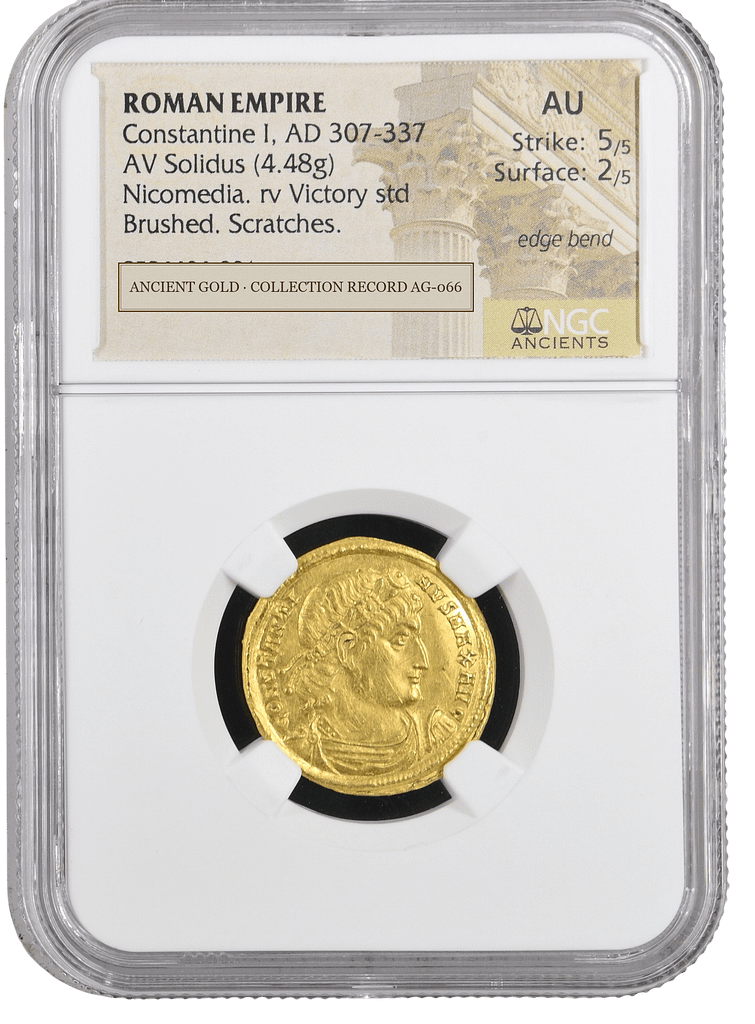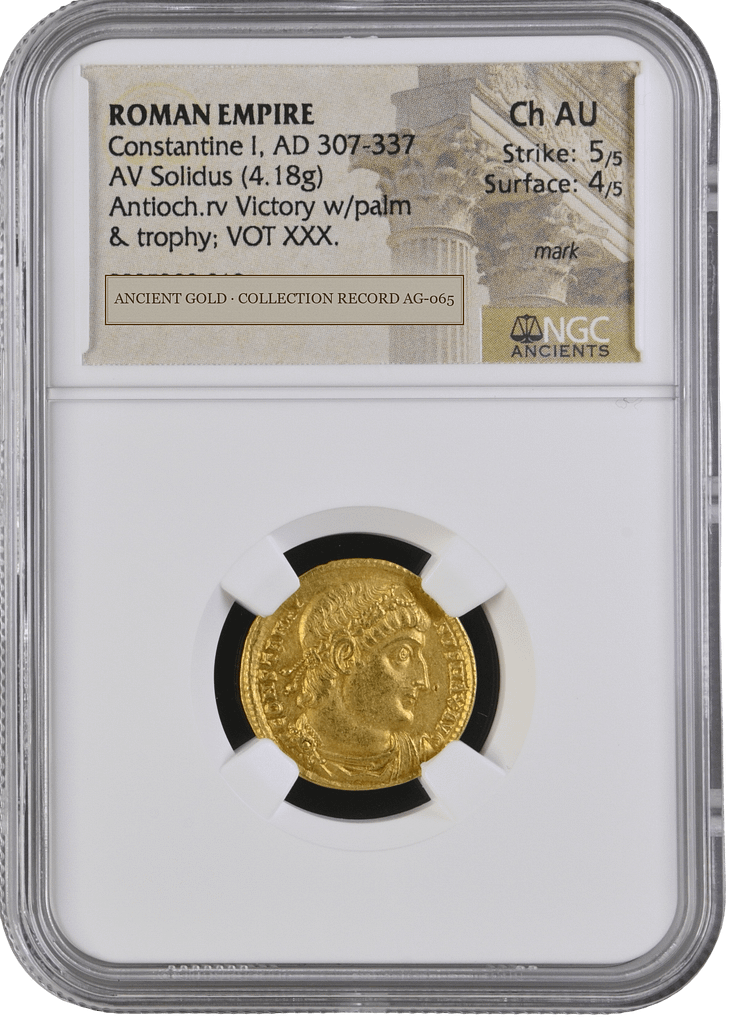
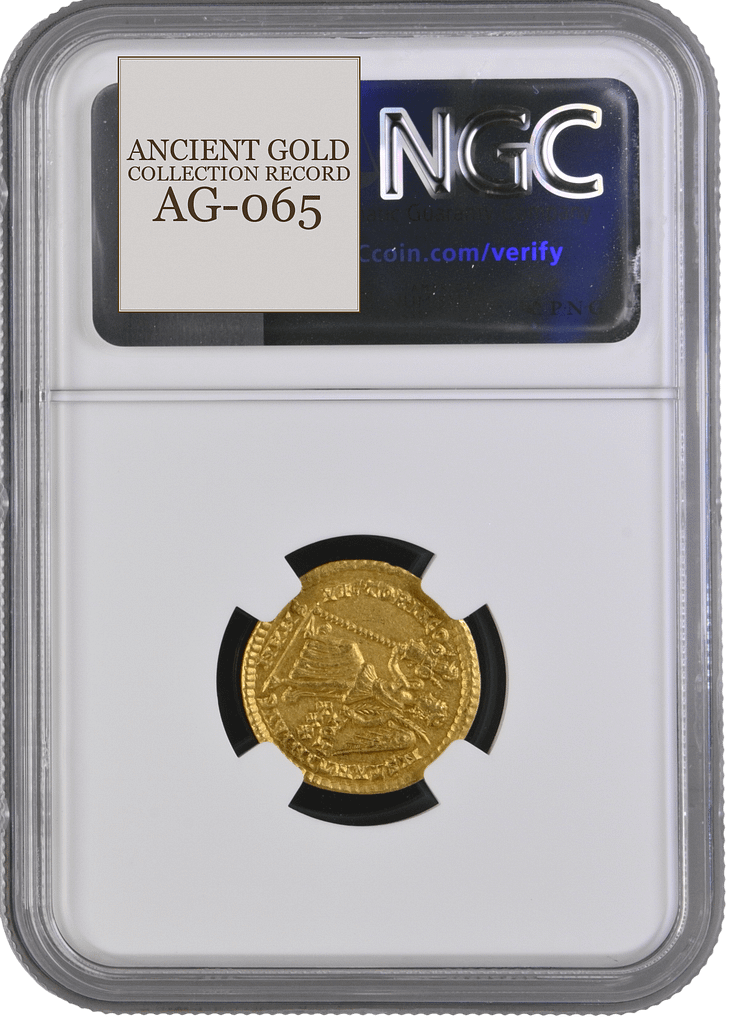
A solidus of Constantine I is a small, exacting object. Most examples measure approximately 20 to 22 millimetres and weigh between 4.40 and 4.55 grams. The intended standard was seventy-two solidi to the Roman pound, producing a theoretical weight near 4.5 grams. Surviving coins often approach that figure closely. Their irregular flans, variable die axes, edge cracks, and occasional double strikes preserve the mechanics of hand production rather than the symmetry of modern coinage.
The denomination emerged at Trier around 309 or 310, though its full imperial role developed only after Constantine defeated Maxentius in 312 and Licinius in 324. Earlier Roman gold had already been reduced in weight, and Diocletian had struck gold at seventy pieces to the pound. Constantine’s achievement was not the invention of a light gold coin. It was the permanent establishment of a new standard at one seventy-second of the pound, supported by sufficient bullion and extended across the empire.
The older aureus disappeared. The solidus endured.
Gold Without Monetary Collapse
Roman silver coinage had suffered repeated debasement. By the later third century the antoninianus had declined from a silver denomination into a largely bronze coin with a superficial silver wash. Gold followed another path. Its weight changed, but its fineness remained exceptionally high.
Scientific analyses of late Roman solidi often produce results in the upper ninety-percent range, with many specimens approaching 98 or 99 percent gold. No single figure applies to every coin. Trace metals, surface alteration, mint practice, and analytical method affect individual readings. Even so, the Constantinian solidus was not a concealed debasement. The state openly reduced the weight of the principal gold unit while defending its purity.
This created a privileged monetary sphere. Taxes assessed in gold, military and administrative payments, diplomatic gifts, land transactions, dowries, and elite savings could be conducted in a dependable medium. Bronze denominations remained unstable and regionally variable. Constantine stabilized imperial gold, not the entire monetary economy.
The reform required metal. Victory supplied it. The defeat of Maxentius gave Constantine control of Italy and Rome. The defeat of Licinius opened the eastern provinces, fiscal reserves, and major centres of bullion supply. Confiscations from political enemies and certain temple estates probably contributed, although no reliable total can be reconstructed.
The solidus was born from conquest and made conquest spendable.
Portraits of a Changing Emperor
Early Constantinian solidi still resemble the coinage of the Tetrarchy. Constantine appears laureate, cuirassed, helmeted, or accompanied by Sol. The portrait can be broad-faced and military, with a heavy neck and forceful jaw. Legends such as CONSTANTINVS P F AVG identify him as dutiful, fortunate, and august.
The reverse often retains traditional deities and personifications. SOLI INVICTO COMITI, “to the Unconquered Sun, companion of the emperor,” presents Sol radiate, holding a globe and raising one hand. Constantine’s patronage of Christianity did not produce an immediate Christian revolution in gold iconography. Sol, Victory, Roma, trophies, captives, and votive shields remained useful because they belonged to an established language of imperial success.
Explicit Christian symbols occur less frequently on Constantine’s solidi than modern retellings often imply. The Chi-Rho appears in selected military and ceremonial contexts, but gold remained conservative. Victory continued to advance, stand, sit, hold palms, carry trophies, and inscribe shields.
By the 320s and 330s the portrait changed. Constantine adopted the diadem, replacing the Roman laurel with an emblem associated with Hellenistic kingship. His face became smoother and more idealized. The head rose, the neck lengthened, and the eyes sometimes turned upward. The pose could evoke Alexander the Great, celestial contemplation, divine election, or Christian devotion. Its ambiguity was politically useful.
The coin no longer showed only a victorious commander. It showed a monarch placed above ordinary military humanity.
Victory, Vows, and Mint Marks
Later solidi commonly proclaim VICTORIA CONSTANTINI AVG, “the Victory of Constantine Augustus.” Victory may advance with trophy and palm, or sit beside a shield inscribed with imperial vows. Formulas such as VOT XX, VOT XXX, or VOT XX MVLT XXX refer to regnal anniversaries and vows for continued rule, not to denominations.
A VOT XXX issue belongs to the celebration of Constantine’s thirtieth regnal year in 335–336. Antiochene examples can carry SMAN in the exergue, an abbreviation of Sacra Moneta Antiochiae. Other marks identify Trier, Lugdunum, Siscia, Thessalonica, Nicomedia, Constantinople, and additional imperial mints. Officina letters distinguish workshops within a mint.
These abbreviations compressed administration into a few characters. Yet attribution requires more than reading an exergue. Portrait style, titulature, field marks, reverse design, officina letters, fabric, and die links must agree. Ancient engravers omitted letters, paired dies incorrectly, altered abbreviations, and produced hybrids. A partially visible mint mark can mislead.
Gold dies were usually cut with greater care than bronze dies, but they were not flawless. Blundered legends, weak strikes, die rust, recutting, cracks, and double impressions occur. Such features help reconstruct workshop practice and can separate official issues from ancient imitations or modern forgeries.
No surviving source records the total number of Constantinian solidi struck. Die studies may estimate relative production for individual issues, but the evidence is distorted. Gold was melted and recoined. Rare types were preferentially collected. Auction records duplicate specimens. Hoards represent local accidents of burial and discovery. Precise empire-wide mintage figures remain unknowable.
The Solidus as Imperial Grammar
A Constantinian solidus can be read as a political sentence. The obverse names the legitimate ruler and defines his status through portrait, dress, and title. The reverse supplies the claim: victory, security, providence, dynastic continuity, fulfilled vows, or dominion over captives. The mint mark identifies the administrative authority behind the statement.
Its stable metal made that statement persuasive.
The denomination also reinforced rank. A semissis represented half a solidus, theoretically about 2.25 grams. Later, the tremissis represented one-third, approximately 1.5 grams. Gold multiples moved in the opposite direction. Two-solidus, four-solidus, and larger presentation pieces were distributed as donatives and ceremonial gifts.
A notable multiple struck at Thessalonica in 327 weighs about 6.83 grams, one and a half solidi. Constantine appears diademed, his gaze raised. On the reverse he stands with spear and trophy above bound captives beneath GLORIA CONSTANTINI AVG. Such pieces were not ordinary market currency. Their weight, scale, and iconography placed the recipient within the imperial hierarchy.
The solidus was divided conceptually into twenty-four siliquae or keratia. This metrological division contributed to the later twenty-four-carat language of gold. A modern term for purity thus preserves the structure of Constantine’s monetary system.
Christianity Through Continuity
Constantine’s reign altered the religious future of the Roman Empire, but the solidus rarely states that change directly. Christ does not appear on a broad Constantinian gold series. The cross is not yet the dominant reverse type. Angels have not yet replaced Victory.
Instead, inherited images were reinterpreted. Victory could remain on Christian imperial coinage because she no longer needed to function as a deity in the traditional cultic sense. She could become an abstract embodiment of success granted to the emperor. Sol could recede without every solar image being immediately prohibited. The upward-looking portrait could address Christian and non-Christian audiences at once.
Constantine’s religious transformation was therefore expressed less by iconographic erasure than by imperial control over meaning. The same symbols circulated under a different political and theological order.
From Solidus to Nomisma
Constantine died in 337. His gold standard survived his sons, his dynasty, and the western Roman Empire. In the eastern empire the solidus became the nomisma. Fifth- and sixth-century examples remained close to 4.5 grams and usually retained high fineness.
The imagery changed gradually. Portraits became frontal. Emperors held spear and shield. Victory evolved into an angel. Crosses entered the fields and reverses. The visual language became explicitly Christian, but the metrological system remained recognizably Constantinian.
The coin paid armies, officials, and diplomats. It moved through taxation, tribute, trade, marriage payments, and royal gifts. It crossed Roman frontiers and inspired imitations among Ostrogoths, Visigoths, Franks, Burgundians, and Anglo-Saxons. Some successor kingdoms retained imperial names and busts after Roman administration had disappeared from their territories. The authority of the Roman emperor remained useful even to rulers who had replaced him.
The denomination lasted because later emperors understood the cost of weakening it. Its stability supported taxation, military payment, diplomacy, and court ritual. Sustained Byzantine debasement did not destroy the old standard until the eleventh century, roughly seven centuries after Constantine’s reform.
The Surviving Coin
Authentication begins with weight, but weight alone proves little. A genuine solidus may be light from wear, clipping, filing, or jewelry use. A counterfeit can be manufactured at exactly 4.50 grams. Diameter varies because flans were not produced to modern tolerances.
Style, dies, and surfaces are more revealing. The form of the eye, diadem, cuirass, legend, trophy, palm branch, and mint mark can identify a workshop tradition. Repeated dies expose shared engraved details. Developing cracks or rust patches can establish the sequence in which coins were struck.
Ancient striking forced metal outward under pressure. Flow lines, edge expansion, crystalline structure, and wear should interact naturally. Cast copies may preserve soft depressions, seams, or copied scratches. Modern pressed forgeries can reproduce relief but fail to reproduce ancient metal movement. Genuine coins are also sometimes tooled, with hair, letters, diadem beads, or facial features sharpened for sale.
Provenance adds another layer. An old pedigree can support authenticity, though it is not absolute proof. A documented hoard context is more valuable. It can establish circulation patterns, chronology, mint relationships, and regional use.
The surviving population is not a neutral record of original production. Gold was melted, inherited, mounted, exported, and recoined. Attractive portraits were saved. Ordinary pieces vanished into later currencies.
Somewhere, an unattributed Constantinian solidus may still sit in an old cabinet, its mint mark partly off the flan and its reverse dismissed as another familiar Victory. One surviving letter could assign it to a different workshop. One die match could connect it to an imperial ceremony whose written record has disappeared.
The gold survived. The occasion did not.