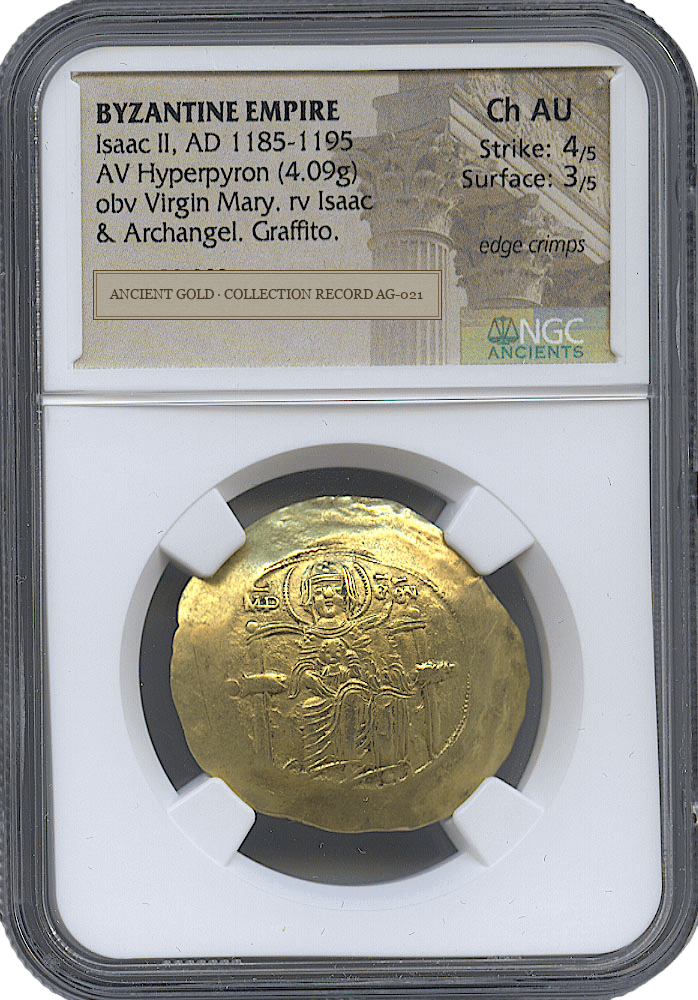
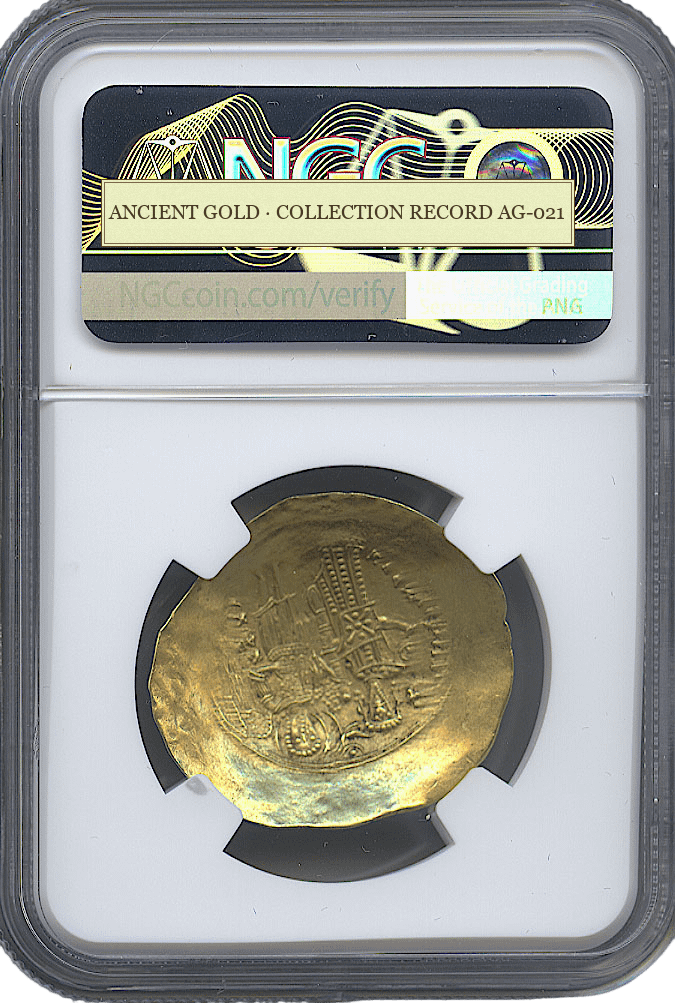
The gold hyperpyron of Isaac II Angelos is shaped like a shallow cup. That curvature immediately separates it from the flat solidi of late Rome and from the compact portrait coins of earlier antiquity. It also changes the act of looking. Light moves unevenly across the surface; figures emerge and recede as the coin is turned. On this example the visual sequence is emphatic: the Virgin and Christ occupy one face, while the emperor stands beside the Archangel Michael on the other. Above them appears the hand of God.
It is difficult to imagine a more complete statement of heavenly protection. It was issued, however, during a reign in which protection was urgently needed.
A Throne Taken in Crisis
Isaac came to power in 1185 after the violent collapse of Andronikos I’s regime. His accession was followed by the defeat of the Norman force that had sacked Thessaloniki, but the empire’s underlying difficulties remained. Rebellion in the Balkans led to the restoration of Bulgarian and Vlach power; warfare, fiscal pressure and court expenditure strained the authority of Constantinople. In 1195 Isaac was deposed and blinded by his brother Alexios III. He would return briefly after the Fourth Crusade reached the capital, but the submitted coin belongs to the first reign, before that final catastrophe.
The hyperpyron therefore comes from neither a stable golden age nor the empire’s final collapse. It belongs to a court still capable of producing sophisticated ceremonial imagery while facing structural dangers it could not master.
The Virgin as Protectress
The obverse carries the abbreviated title MP ΘV, “Mother of God.” The Virgin is enthroned facing, holding the image of Christ before her breast. The composition is hieratic rather than domestic. Mary does not appear as a figure absorbed in maternal affection; she is the solemn bearer of the incarnate Christ and the protectress long associated with Constantinople.
Placing this image on gold gave devotion a public, governmental function. Every payment or ceremonial distribution made the Virgin’s protection part of the empire’s monetary identity. The throne establishes order, while the frontal pose makes the sacred figures present to the viewer. On the curved flan, that presence changes with the light but never disappears.
Emperor and Archangel
The reverse names Isaac as despotes. He stands beside the Archangel Michael, whose wings and military character distinguish celestial command from earthly rule. Between them they hold a sheathed sword. The weapon is important precisely because it is enclosed. It signifies military authority under control, an emblem of legitimate power rather than an episode of combat.
Above the pair, the manus Dei descends from heaven. The hand of God does not merely bless Isaac in isolation; it completes a vertical hierarchy that runs from divine will through the archangel to the emperor. The composition is dense, but its logic is clear. Isaac’s authority is strongest when shown as received and supervised, not self-created.
The juxtaposition inevitably invites notice of the family name Angelos and the presence of an angelic protector. Yet the image is more than a heraldic pun. Michael had long been understood as commander of the heavenly host and guardian of Christian sovereignty. His sword made him an apt companion for an emperor whose accession and survival depended upon military success. The type converts that need into a sacred partnership.
Gold After the Komnenian Reform
The hyperpyron had been introduced by Alexios I Komnenos late in the eleventh century as part of a fundamental monetary reform. By Isaac’s reign it remained the empire’s principal gold denomination, although its fineness had declined from the standard achieved under the early Komnenoi. The word “gold” therefore describes both material and institutional memory. The denomination still carried the prestige of the restored currency even as its alloy registered a changing economy.
This specimen weighs 4.09 grams and measures 32 millimetres. Its broad, thin, concave fabric gave the engraver a generous field but made complete striking difficult. Areas of softness are normal consequences of transferring two complex designs onto a curved blank. The extremely fine preservation allows the central relationship of emperor, archangel and sword to remain legible. Classified as Sear 2001, it belongs to the standard first-reign issue from Constantinople.
The Authority the Coin Claims
Coins are often asked to illustrate history after the fact. This hyperpyron does something more interesting: it records the political theology with which Isaac’s court confronted its present. The empire’s problems are not pictured, nor are they denied in words. Instead, the coin constructs the order those problems threatened. The Virgin carries Christ; Michael attends the emperor; God’s hand confirms the arrangement.
Seen eight centuries later, the image has acquired an irony the die engraver could not intend. Sacred protection did not prevent Isaac’s deposition, the renewed struggle for the throne or the capture of Constantinople in 1204. Yet that later knowledge should not reduce the coin to failed propaganda. Its imagery reveals what legitimate government meant within the Byzantine court: rule grounded in orthodoxy, protected by heavenly force and enacted through a divinely ordered office.
The hyperpyron survives as both precious object and historical argument. Its gold has crossed the distance intact; its curved surface still makes the sacred hierarchy visible. Few documents of Isaac II’s reign state so economically what the emperor hoped power to be.