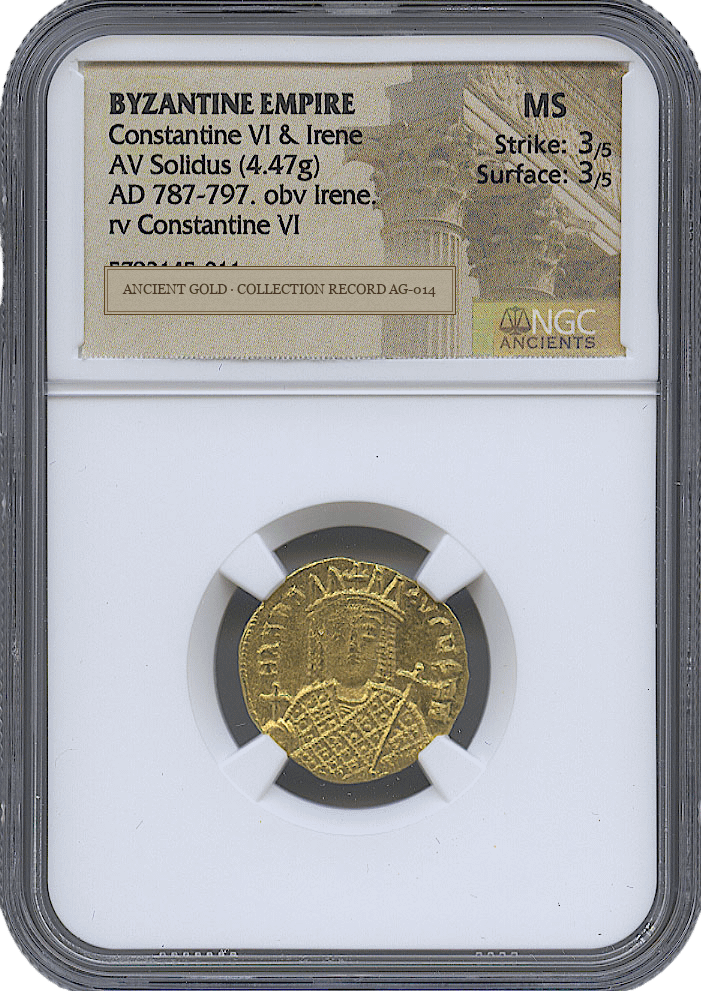
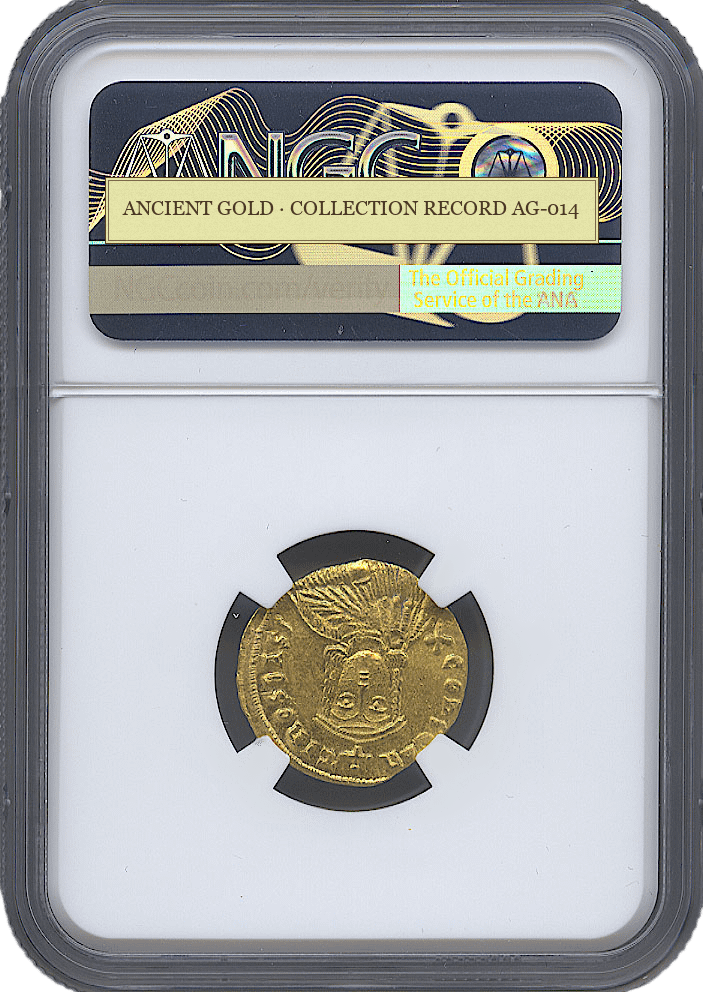
What does this coin show? Struck at Constantinople in AD 793–797, this gold solidus presents Empress Irene and her son Constantine VI on separate faces, each crowned and equipped with the insignia of Christian monarchy. Its arrangement is unusually direct: Irene occupies the obverse in the loros, holding a globus cruciger and cruciform sceptre, while Constantine appears on the reverse in the chlamys with a globus cruciger and akakia. A rare obverse-legend variant makes this 4.46-gram piece an especially precise witness to a divided imperial partnership.
A Reign Shared and Contested
Constantine VI inherited the eastern Roman throne in AD 780 while still a child. His mother Irene governed as regent, placing the court’s practical authority in her hands while the dynasty continued in her son’s name. That arrangement did not remain stable. As Constantine approached adulthood, the question was no longer whether he was emperor, but whether he could exercise power independently of the empress who had ruled for him.
Military support briefly allowed Constantine to remove Irene from government in 790. Two years later she returned to the imperial partnership. The gold coinage of the restored association belongs to this tense second phase, when mother and son were presented not as regent and minor but as two holders of imperial dignity. The supplied attribution dates this solidus to AD 793–797, the final years before their political struggle ended in Constantine’s deposition.
Irene Takes the Obverse
The obverse legend names Irene as Augusta. She faces the viewer beneath a crown and wears the loros, the elaborate ceremonial garment that had become one of the clearest visual signs of imperial rank. In one hand she holds the globus cruciger, the cross-surmounted globe that joins universal rule to Christian authority; in the other is a cruciform sceptre.
Nothing in this portrait describes Irene as merely the emperor’s mother. Her costume, regalia and frontal presentation give her a complete sovereign image. Her position on the obverse strengthens that message. Byzantine coins did not operate with a simple modern rule that one face was always more important, yet the decision to lead with Irene makes the hierarchy of the design difficult to miss.
Constantine on the Reverse
Constantine VI appears crowned and facing on the reverse beneath the legend naming him as basileus. He wears the chlamys, the imperial cloak fastened at the shoulder, and holds his own globus cruciger. His other attribute is the akakia, a ceremonial object associated with the discipline and humility expected of the ruler.
The two portraits therefore assert equality and distinction at the same time. Both figures possess the cross-bearing globe and the frontal authority of the imperial image. Their garments and secondary attributes distinguish their courtly roles. Gold turns an unstable political settlement into a balanced composition: one sovereign on each face, each complete, neither visually dependent upon the other.
A Legend Variant Worth Recording
The individual coin measures 20 millimetres, weighs 4.46 grams and has a die axis of 6h. Its attribution is Sear 1594, with the obverse legend recorded as a variant of Füeg 5.D and Dumbarton Oaks 3c. The supplied catalogue description grades it Extremely Fine and describes the legend variety as extremely rare and apparently unpublished.
That distinction matters. A reference number identifies the broader type, but the exact sequence and form of letters can preserve evidence for a particular die, workshop practice or short-lived issue. On a coinage in which legends are often compressed, irregular or rendered through mixed Greek and Latin forms, a variant must be recorded exactly rather than normalised into the nearest familiar reading.
Gold at the End of a Dynasty
The apparent symmetry of the coin did not reflect a durable political peace. In 797 Irene’s supporters removed Constantine from power, after which she ruled alone until 802. Later events give the paired portraits an unavoidable poignancy, but the solidus should first be read as contemporary official language. At the moment it was struck, the state was not commemorating a rupture. It was declaring that two contested authorities formed one legitimate government.
This is why the coin is more than an illustration of court conflict. It documents the mechanisms by which Byzantine monarchy made authority visible: frontal portraiture, ceremonial dress, sacred regalia, carefully ordered names and the dependable material of the solidus itself. Even a rare variation in the obverse legend belongs to that system, preserving the work of the mint within the larger theatre of dynastic rule.
Object Note
Constantine VI with Irene, AV solidus. Constantinople, AD 793–797. Obverse: crowned facing bust of Irene wearing the loros, holding a globus cruciger and cruciform sceptre. Reverse: crowned facing bust of Constantine VI wearing the chlamys, holding a globus cruciger and akakia. 4.46 g; 20 mm; 6h. Füeg 5.D var. (obverse legend); DOC 3c var. (same); Sear 1594. Extremely Fine; described in the supplied catalogue record as extremely rare and apparently unpublished with this obverse-legend variant.