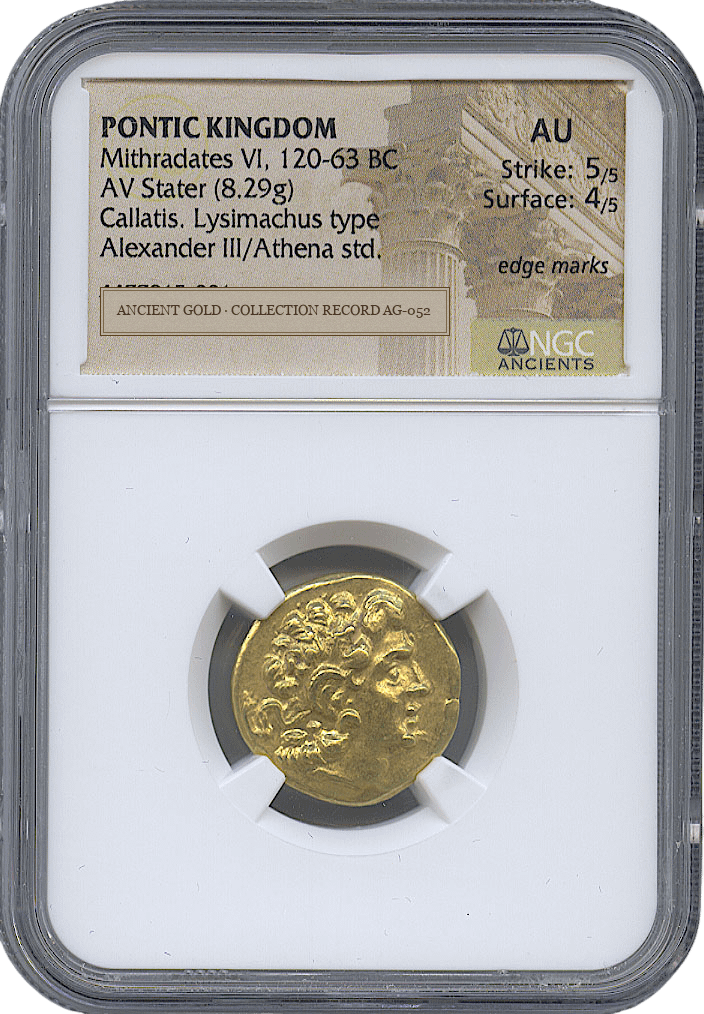
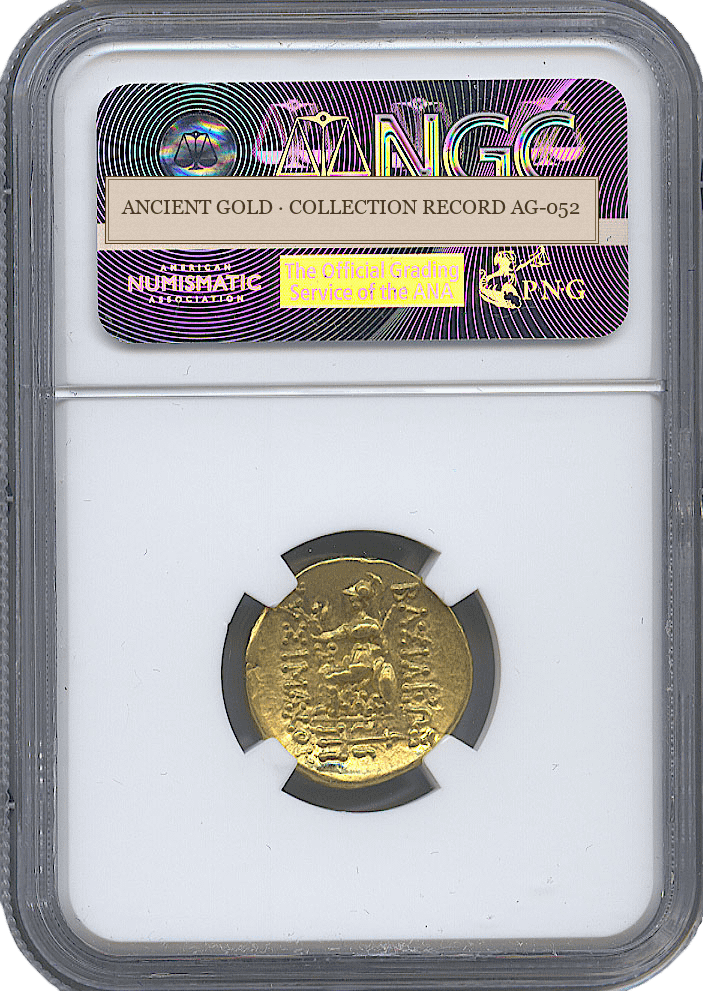
Mithradates VI Eupator ruled Pontos from 120 to 63 BC and became Rome’s most formidable opponent in the Greek East. AG-052 uses an image already heavy with history: the deified head of Alexander with the horn of Ammon on the obverse, and Athena enthroned with Nike on the reverse. Reuse was not imitation without meaning. It was a claim to succession.
A portrait that outlived its ruler
Alexander’s image continued to authorize money long after his death. The horn of Ammon presents him as more than a mortal king, while idealized features detach the portrait from ordinary likeness. For Mithradates, this visual inheritance offered a language understood across Hellenistic territories. It placed his kingdom within the political memory of Alexander and the successor monarchies.
Athena controls victory
On the reverse, Athena sits with spear and shield while holding Nike. The composition makes victory subordinate to strategic and divinely protected authority. A small standing Nike is not an ornamental accessory: she completes the claim that military success rests in the hand of the enthroned goddess and, by implication, favours the issuing power.
Comparison with Macedonian gold
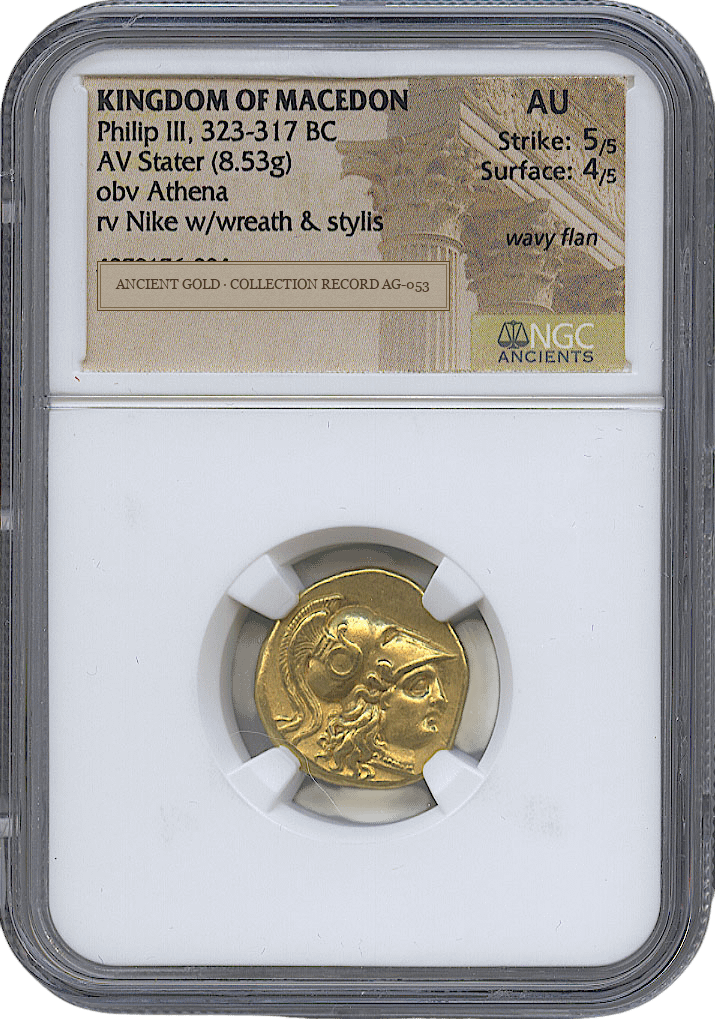
AG-053, issued in the name of Philip III Arrhidaios, pairs Athena’s helmeted head with a full standing Nike. AG-052 rearranges related Hellenistic concepts around the remembered figure of Alexander and an enthroned Athena. Comparing the two prevents the broad labels “Athena” and “Nike” from flattening distinct political compositions.
Memory as a monetary resource
Trusted coin types accumulated authority through use. A later king could reactivate that trust while adding contemporary meaning. Mithradates’ wars with Rome made Hellenistic memory politically urgent: his coinage could present resistance not as provincial rebellion but as leadership grounded in an older royal order.
Questions readers ask
Is the obverse a portrait of Mithradates?
The type is conventionally read as the deified Alexander. Any resemblance or deliberate association with Mithradates must be argued from die style and typology rather than assumed from the issuer.
Why copy an older design?
Because recognition is useful. An established type could support monetary trust and make a new political claim appear continuous with admired precedent.
Does the coin prove Mithradates wanted to recreate Alexander’s empire?
No. It proves that his authority used Alexandrian and Hellenistic visual language. Larger political intentions require historical sources beyond the coin.