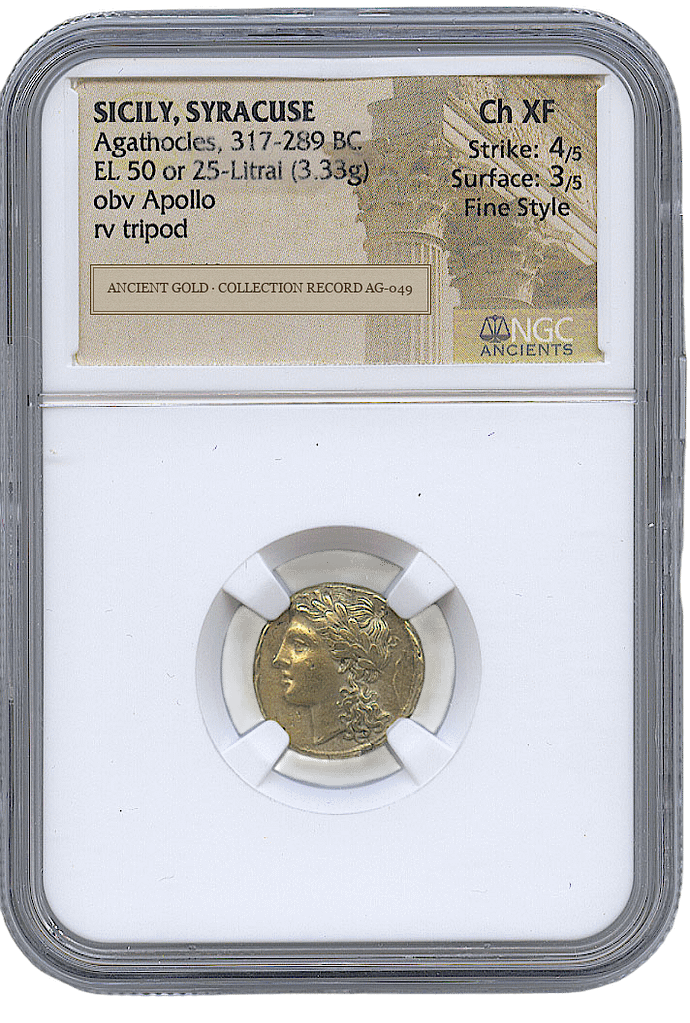
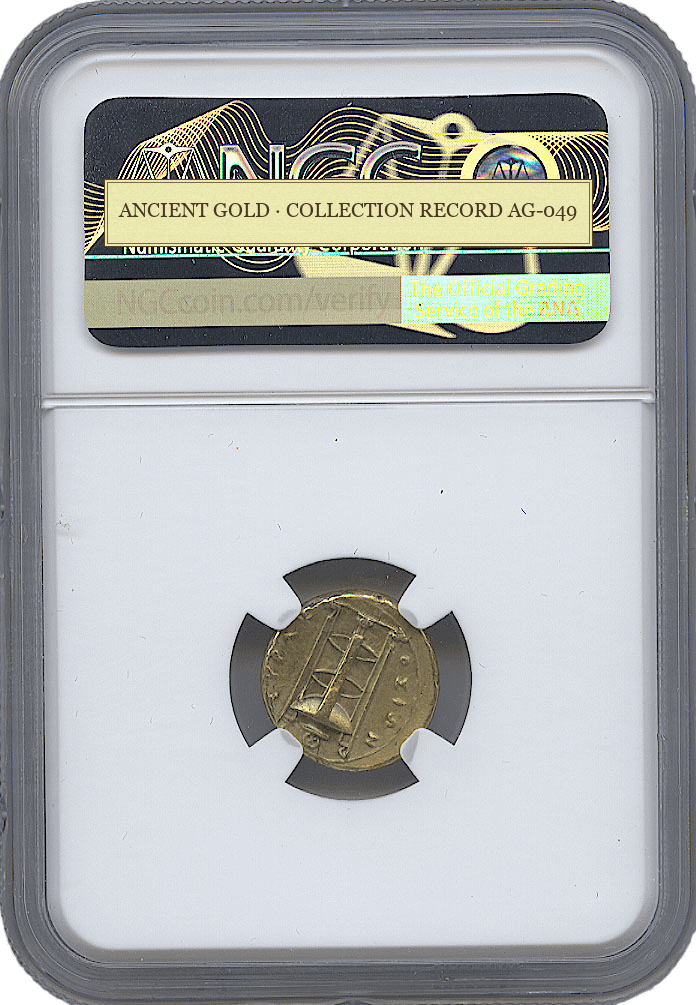
Agathokles ruled Syracuse during a period of war, territorial ambition and changing definitions of kingship in the western Greek world. AG-049, an electrum denomination of 50 or 25 litrai dated to 317–289 BC, places the laureate head of Apollo on the obverse and a tripod on the reverse. The pairing makes religion part of political communication.
Apollo is more than a portrait
The laurel identifies Apollo and evokes purification, music, ordered knowledge and prophecy. On a coin, the god also connects the issuing authority to a shared Greek sacred world. That connection mattered in Sicily, where local history, rivalry with Carthage and wider Hellenistic culture met. The image does not prove private devotion by Agathokles; it shows the public language his authority chose to circulate.
The tripod as an answering symbol
The reverse tripod condenses the Delphic oracle into an object that remains legible at very small scale. It answers the divine head with a cult instrument rather than a narrative scene. Because the two faces reinforce one another, the type is stronger than either image alone: Apollo is named visually, and the tripod clarifies the prophetic field of meaning.
Electrum and controlled value
AG-049 weighs 3.33 grams. Its alloy connects it materially with a long electrum tradition, but its imagery belongs to a much later monetary culture than AG-051. By Agathokles’ age, coin types could address audiences already accustomed to reading divine attributes, ethnic identities and royal claims. Metal, denomination and iconography worked together.
From civic command to kingship
Agathokles rose through military power and eventually adopted the royal title. Coinage could make such transformation appear continuous: familiar sacred images gave stability to an authority whose political position had changed. The coin should not be treated as a newspaper report of a single event. It is better understood as repeated official representation designed to remain acceptable through payment and exchange.
Questions readers ask
Does the tripod prove the coin was struck at Delphi?
No. The tripod is an attribute of Apollo and prophecy. Mint attribution requires separate typological and historical evidence.
Why use electrum instead of pure gold?
The choice belongs to the denomination and monetary practice of the issuing system. Exact alloy composition cannot be inferred from the catalogue photograph.
Can the image tell us how ordinary users understood it?
Only partly. The symbols were designed to be recognizable, but individual responses are not preserved. The safest claim concerns the official associations the type made available.