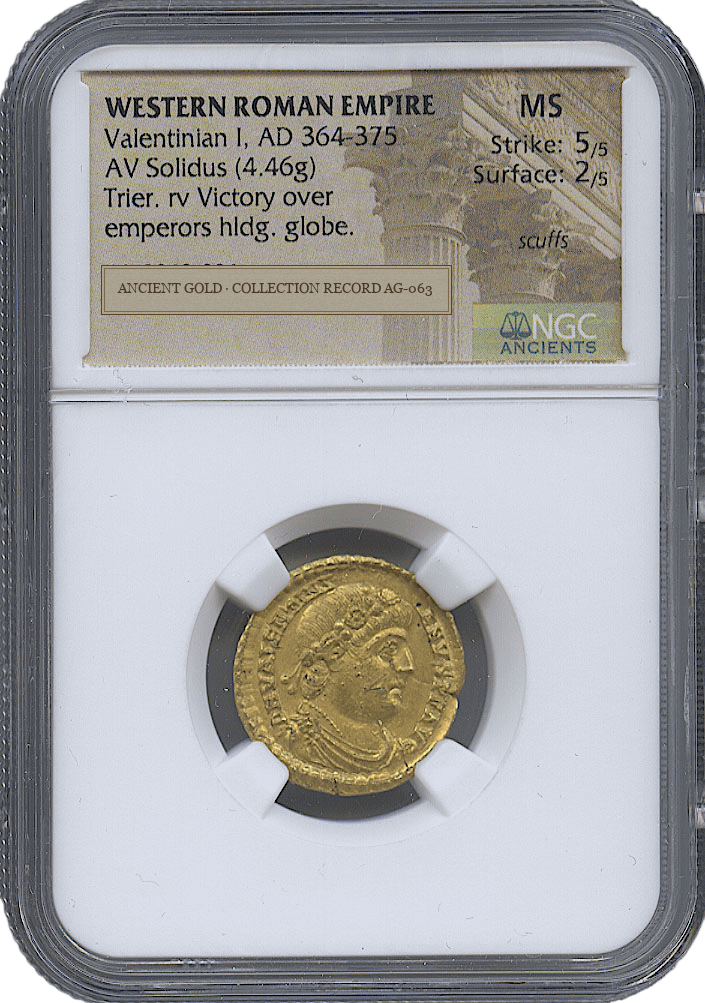
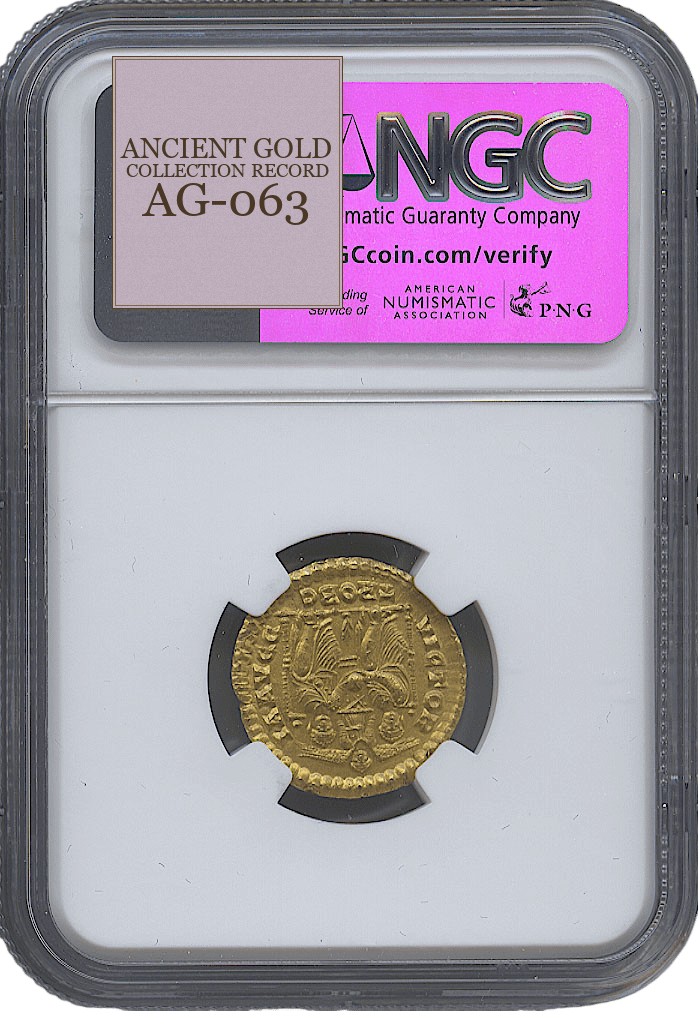
The solidus struck for Valentinian I at Trier in the final years of his reign presents a government without fracture. On the obverse, the senior western emperor appears in military dress, his portrait framed by the formal titles of a Roman Augustus. On the reverse, two emperors sit together and touch the same globe. Victory spreads her wings above them; a palm rises below. The legend declares VICTORIA AVGG—“the victory of the emperors.”
Every element is composed to suppress uncertainty. The globe has one surface and two guardians. The throne is shared, the victory collective, the state ordered. Yet the coin was issued from a frontier capital during years of almost continuous pressure, when the practical burdens of government had been divided among several Augusti and when Valentinian spent much of his reign moving between threatened regions.
Its force lies in that distance between assertion and circumstance. The type does not illustrate the frontier wars. It gives the political answer to them.
An Emperor Chosen by the Army
Valentinian was born at Cibalae in Pannonia in 321, the son of an army officer. His career belonged to the mobile military establishment of the fourth century rather than to the senatorial aristocracy of Rome. When the emperor Jovian died unexpectedly in February 364, senior civil and military officials met at Nicaea and selected Valentinian. Ammianus Marcellinus, the principal narrative source for the reign, records both the managed nature of the choice and the army’s demand that a colleague be appointed.
Valentinian raised his brother Valens to the rank of Augustus at Constantinople in March. The brothers divided responsibility: Valens governed the east, while Valentinian took the west, including Gaul, Britain, Africa, Italy and the strategically exposed Danubian provinces. This was not a formal partition of the Roman state. Laws and coin legends continued to speak in the language of a common empire, even as separate courts and commands became indispensable.
Dynasty followed. After a grave illness at Amiens in 367, Valentinian proclaimed his eight-year-old son Gratian Augustus. The ruling college now combined the senior emperor, his brother and his child. The appointment secured succession but also created a representational problem. Imperial power was distributed among men of unequal age and experience; official imagery had to present that plurality as concord.
The gold coinage was particularly suited to the task. Solidi paid high officials and troops, accompanied imperial gifts and stored wealth. They circulated among people whose loyalty sustained the regime. A reverse about shared rule therefore addressed the political class most likely to recognize its urgency.
Trier and the Government of the Rhine
Augusta Treverorum—modern Trier—was far from Rome but close to the work of western government. Imperial residences, administrative offices and a productive mint had made it one of the principal capitals of the later empire. From there the court could reach the Rhine armies, receive embassies and direct the fiscal systems that supported frontier defence.
Valentinian established himself in Gaul after Alamannic incursions in 365. He campaigned, negotiated and built. Ammianus describes forts, watchtowers and attempts to strengthen the river line, while the panegyrics of Symmachus present the emperor’s presence among the armies as proof that taxes and obedience produced security. The literary sources differ in purpose, but both show a court arranged around the frontier.
The mint mark of the solidus identifies Trier. In forms such as TROBS, TROBC or TROBT, TR names the city, OB refers to refined gold and the final letter marks the workshop. These small letters anchor the universal language of victory to a particular institution. The coin’s message might encompass the whole Roman world; its manufacture belonged to a staffed mint operating beside the Rhine command.
The Ancient Gold specimen weighs 4.46 grams, close to the Constantinian standard of seventy-two solidi to the Roman pound. Its weight expresses a kind of continuity that the frontier desperately needed. Emperors changed, courts moved and armies fought, but the gold unit remained recognizably Roman.
The Soldier’s Portrait
Valentinian’s obverse is conventional but not empty. The bust faces right, draped and cuirassed, with a rosette diadem tied around the head. The cuirass recalls military command; the diadem marks sovereignty. The legend expands to Dominus Noster Valentinianus Pius Felix Augustus: “Our Lord Valentinian, dutiful and fortunate Augustus.”
Late Roman portraiture did not depend on individualized likeness in the modern sense. Die engravers worked within a controlled vocabulary of large eyes, firm jaw, ordered hair and imperial insignia. Some dies give Valentinian a compact, forceful head; others soften or lengthen the features. The type mattered more than physiognomic consistency.
That does not make style irrelevant. The quality of cutting determined how authority appeared. A strong portrait could make the diadem, eye, ear, armour and folds of the cloak legible at a diameter of about twenty millimetres. Variations also help establish die links and workshop practice. The official image was standardized, but its execution remained the work of individual hands.
The title pius felix joined religious duty to divinely favoured success. Valentinian was a Nicene Christian, while Valens supported the Homoian creed, yet official collegiality survived their theological difference. On the coin, the source of legitimacy is expressed through inherited Roman titles and victory rather than a doctrinal emblem. The military state speaks first.
Two Emperors, One Globe
The reverse belongs to a long Roman practice of turning co-rule into symmetry. Two emperors sit frontally on a broad throne and place their hands upon a globe between them. Above, the upper body of Victory emerges with wings spread. A palm branch below completes the language of triumph. The type was issued in the names of different members of the ruling college.
On late Trier solidi of Valentinian, the enthroned pair is commonly understood as Valentinian and Gratian: the senior ruler and the son he had made Augustus. The image is deliberately less specific than the obverse. It does not supply individual labels within the scene, and its legend speaks of the Augusti in the plural. Viewers could read dynastic succession, fraternal concord and the unity of the imperial college at once.
The globe is the centre of the argument. Each emperor touches it, but neither divides it. Roman rule may be administered by several courts; the orbis Romanus remains one. The gesture avoids the visual language of competition. Shared possession becomes shared responsibility.
Victory hovers behind the throne rather than approaching one emperor with a wreath. Her wings shelter the pair, and the palm below repeats the claim. The victory belongs to the Augusti collectively. No named enemy appears, no captive is dragged, and no battle is located. This abstraction allowed the type to answer many crises without being tied to any single campaign.
The Frontier Behind the Image
Valentinian’s western reign was defined by regional emergencies. Alamanni crossed the Rhine; Saxon, Pictish and Scotti attacks contributed to the crisis in Britain; the revolt of Firmus destabilized Africa; Burgundian diplomacy and shifting alliances complicated the northern frontier. The emperor and his commanders restored control, but success required continuous movement and expenditure.
In 368 Valentinian led a major campaign across the Rhine. Later years were devoted to fortification and to managing relations with peoples beyond the boundary. The Rhine was not a sealed wall. Trade, recruitment, tribute, settlement and violence passed across it. Imperial policy combined punitive expeditions with negotiated arrangements and the conspicuous construction of defences.
In 374 trouble on the middle Danube drew Valentinian east. Roman construction of a fort in Quadi territory and the killing of their king Gabinius had helped provoke attacks into Pannonia and Valeria. Valentinian reached the region in 375, crossed the Danube on campaign and then received Quadi envoys at Brigetio.
Ammianus gives the emperor’s death a dramatic moral shape. During the audience Valentinian became enraged at the envoys’ defence, collapsed and died on 17 November 375. The episode suited Ammianus’ portrait of a ruler whose energy and severity could become uncontrolled anger. Whatever the literary colouring, the sudden death was politically dangerous. Gratian was absent, and officers proclaimed Valentinian’s four-year-old son Valentinian II, adding another child Augustus to the western settlement.
Victory as a Political Tense
The VICTORIA AVGG reverse is sometimes described as propaganda, a useful word if it is not taken to mean simple deception. Roman coin types were official speech. They selected virtues and relationships that the government wished to make normal: victory, concord, security, restoration and the felicity of the age.
The tense of that speech was elastic. Victory could commemorate a success, anticipate one, or describe the enduring condition supposedly created by legitimate emperors. The late Trier solidus does not ask whether every frontier was quiet in the year of issue. It claims that joint imperial authority is victorious by nature and that the world remains held between lawful Augusti.
Gold strengthened the assertion. The solidus had survived the monetary disruptions of the third century and remained stable across changing dynasties. A reliable coin could make political continuity tangible. Its acceptance depended on the state’s ability to maintain weight and fineness; its imagery presented the same state as capable of maintaining order.
Yet the coin should not be read as a forecast of western collapse. Valentinian’s administration remained formidable, and the empire of 375 retained deep fiscal, military and institutional resources. The later history of the west gives the phrase “final years” a retrospective gravity, but this was not the last Roman solidus. The denomination continued for centuries. What ended was Valentinian’s particular frontier regime.
The Object and Its Claim
The Ancient Gold coin is graded NGC Mint State with a 5/5 strike and 2/5 surface, with scuffs noted. Those assessments describe different moments in the object’s life. The strong strike records an effective transfer from dies to flan: portrait, legends and complex reverse were impressed with clarity. The lower surface rating and scuffs record what happened after striking.
Such distinctions matter more than a single grade. Ancient coins were not made within collars under mechanized pressure. Centring, die wear and the force of the blow varied. A coin can be unworn yet poorly struck, or beautifully struck yet marked by later handling. The specimen’s value as evidence lies in the combination.
Close examination should include the exergual mint mark, the shape of the rosette diadem, the arrangement of the emperors’ hands and the form of Victory’s wings. Comparison may identify the exact workshop and connect the coin to others from the same dies. The broad historical interpretation rests upon such small observations.
The reverse remains arresting because it makes strain invisible without becoming meaningless. Two rulers hold one globe while Victory guarantees their concord. Behind that calm geometry stood Rhine campaigns, Danubian fortifications, disputed borders and a dynasty still securing its future. Valentinian’s solidus did not record the frontier as it looked. It recorded the order for which the frontier was being fought.