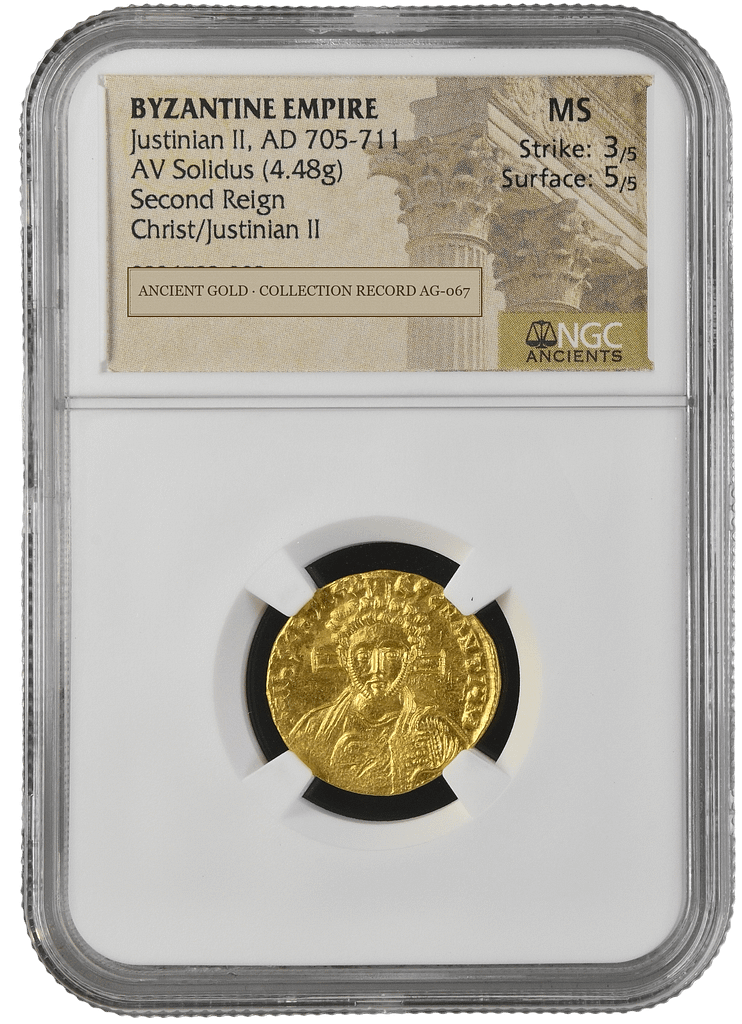
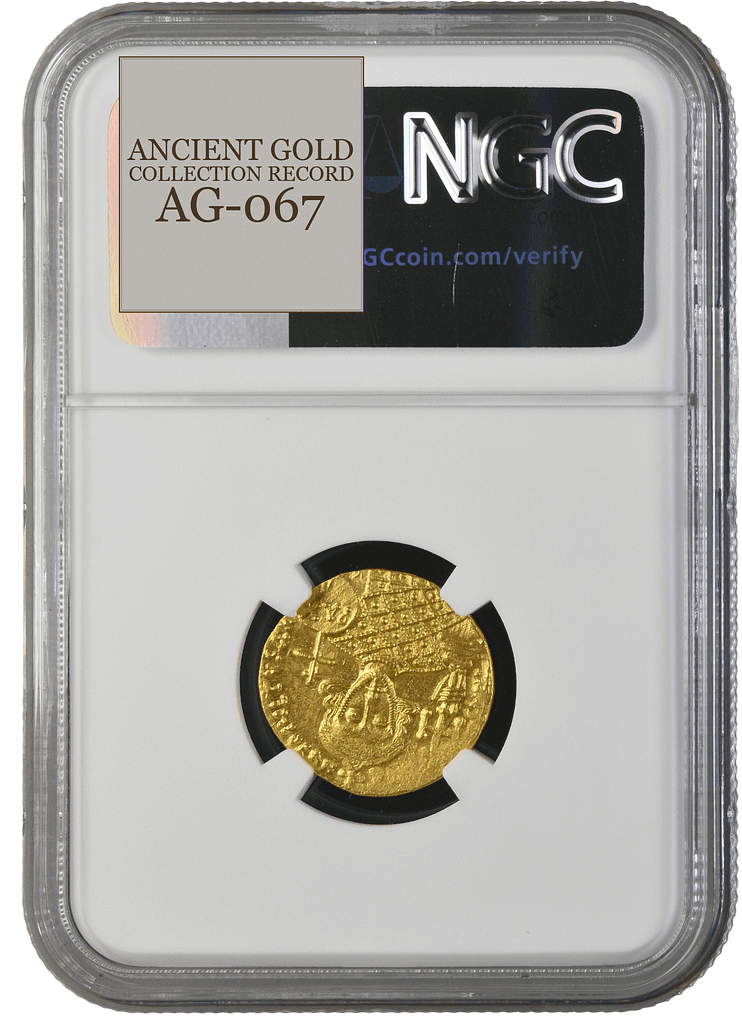
The gold solidus of Justinian II’s second reign offers no admission of defeat. Christ faces the viewer as King of those who rule. On the other side the restored emperor appears frontally in crown and loros, holding a stepped cross and a globe marked PAX. The design is formal, balanced and absolute. Nothing in it concedes that Justinian had already been overthrown, mutilated, exiled for a decade and returned to Constantinople with foreign military support.
That silence is the source of the coin’s intensity. Byzantine political mutilation was intended to make a rival physically unfit for sovereignty. Justinian’s recovery of the throne in 705 broke the logic of the punishment. His coinage did not explain the exception; it asserted that no exception existed. The emperor’s body is made whole by office, and his office is placed directly beneath Christ.
Gold became the medium of restoration. The coin asks its holder to accept a sacred hierarchy more stable than the violence through which the regime had passed.
The First Reign and the Image of Christ
Justinian succeeded his father Constantine IV in 685, still in his teens. He inherited an empire that had survived the first great Arab assaults on Constantinople but had lost Syria, Palestine and Egypt. His early reign mixed military ambition, forced resettlement, fiscal pressure and ecclesiastical legislation. The Quinisext Council of 691–692 attempted to regulate Christian practice and sharpened disputes with Rome.
During the closing years of that first reign, Justinian made one of the decisive changes in Byzantine coinage. A facing bust of Christ Pantokrator appeared on the obverse of the gold solidus, accompanied by the proclamation that Christ was King of those who rule. The emperor moved to the reverse, holding a cross and styled the servant of Christ. Christian signs had been present on Roman money for centuries; the full sacred portrait and the resulting hierarchy were new.
The change had artistic, theological and diplomatic dimensions. Coinage circulated an official image of Christ through the empire and beyond it. The type appeared during an age in which the legitimacy of religious imagery and the relationship between Christian empire and the Umayyad caliphate were becoming increasingly visible in public art and money. It should not be reduced to a single cause, but its claim is plain: Christ is the ultimate sovereign, and the emperor rules in service to him.
In 695 rebellion ended the experiment. Leontios seized power. Justinian’s nose was cut and his tongue may also have been damaged before he was sent to Cherson in Crimea. The mutilation was practical political language. A visibly disfigured man was not expected to return as God’s perfect imperial image.
Exile and Return
Justinian survived where the regime expected him to disappear. When officials at Cherson moved against him, he escaped to the Khazars and married a sister of the khagan, who took the name Theodora. A subsequent attempt to surrender or kill him failed. He then sought the aid of Tervel, ruler of the Bulgars.
In 705 Tervel supplied the force that brought Justinian to the walls of Constantinople. After attempts to secure entry openly failed, Justinian and companions passed through a water conduit and contacted supporters inside the city. Tiberios III’s government collapsed. The mutilated exile entered the palace and resumed the imperial title.
The restoration overturned a convention rather than a written constitutional rule. Physical integrity had made the emperor a fitting public body; blinding or cutting the nose could remove a rival without the sin and political danger of execution. Justinian demonstrated that military success and possession of the capital could defeat that symbolism.
His response was not reconciliation. Leontios and Tiberios III were humiliated and executed; Patriarch Kallinikos, who had participated in the previous changes of regime, was blinded and exiled. Tervel received extraordinary honours, including the rank of Caesar. The restored court was born from vengeance, debt and a legitimacy that needed to appear unquestionable.
A Different Face of Christ
The solidus of the second reign restores Christ to the obverse, but not in the same form used before 695. The earlier type shows the long-haired, bearded Pantokrator familiar from later icons. The new type presents Christ with shorter, tightly curled hair and a shorter beard. A cross stands behind the head; the right hand blesses and the left holds the Gospel book.
The alteration has prompted attempts to identify particular artistic models or theological intentions. Exact dependence is difficult to prove. What the coin establishes is that the imperial mint recognized more than one authoritative way of imaging Christ. The second portrait was not an engraver’s casual variation. It was a deliberate type used across the restored gold currency.
The legend reads, in compressed Latin forms, “Our Lord Jesus Christ, King of those who rule.” The royal title belongs first to Christ. Justinian’s own legend on the reverse names him perpetual Augustus, but the two inscriptions create an explicit rank: earthly government is subordinate to the divine ruler whose image occupies the primary face.
This hierarchy was especially useful after restoration. Justinian could not rely on uninterrupted possession, physical perfection or universal consent. The coin places his authority where mutilation cannot reach it. If Christ is King over emperors, then the returned emperor presents himself as the lawful instrument of a higher sovereignty.
The Restored Emperor
Justinian faces the viewer in crown and loros. The jewelled garment, bound around the body, belonged to the ceremonial vocabulary of imperial office. He holds a cross potent set upon steps and a patriarchal cross mounted on a globe inscribed PAX. The objects occupy so much of the field that the emperor appears almost enclosed by signs of Christian dominion.
The portrait does not advertise his mutilation. Some later narratives imagined a golden replacement for the missing nose, but the coins are not reliable evidence for such a prosthesis. Their frontal face is a conventional imperial image, shaped by die style and the requirements of the type. It restores the office, not the anatomy.
PAX is the most arresting word on the reverse. It invokes peace on the globe of rule, yet the regime had returned through force and immediately pursued its enemies. The apparent contradiction is characteristic of imperial language. Roman peace was not the absence of coercion; it was the order produced by legitimate victory. On Justinian’s coin, peace is something the restored emperor holds.
The cross on steps recalls the great symbol erected on Golgotha and the stepped crosses that had dominated earlier Byzantine gold. The patriarchal cross and globe join Christian authority to universal rule. Together they make the emperor’s body secondary. His claim resides in the regalia, legend and sacred objects that surround him.
Restoration and Succession
Justinian’s return solved one problem and created another. A restored emperor needed a future. His Khazar wife Theodora was brought to Constantinople and crowned Augusta. Their young son Tiberios was proclaimed co-emperor, probably in 706. Later solidi replace the solitary Justinian reverse with paired busts of father and son holding a cross.
The succession type repeated the strategy of the restoration issue. It did not recount the dangers faced by the dynasty. It made continuity visible. Tiberios, born during exile, became an Augustus through the recovered authority of his father. The ruling family was presented as if it had never been interrupted.
This matters when reading the earlier solitary type represented in the Ancient Gold collection. Its imagery belongs to the first phase of regained rule, when Justinian’s personal restoration was the central fact. Christ confronts the viewer; Justinian stands alone beneath him; PAX announces the order he claims to have recovered. The type is therefore often dated to 705–706, before the co-emperor entered the main gold design, although cataloguing conventions can vary.
The progression from restored ruler to restored dynasty shows how closely coinage followed constitutional presentation. A change of reverse did not simply provide artistic variety. It altered the public description of who held imperial power.
The Violence Outside the Frame
The second reign did not achieve the stability proclaimed by the solidus. Justinian’s relations with Tervel deteriorated, and a campaign against the Bulgars ended badly at Anchialos in 708. Arab forces advanced in Asia Minor. Imperial action against Ravenna deepened western grievances, even though relations with Pope Constantine later improved through negotiation over the Quinisext canons.
Cherson, the place of Justinian’s exile, became the fatal point. A punitive expedition sent against the city contributed to revolt. The officer Bardanes was proclaimed emperor as Philippikos, and the rebellion moved toward Constantinople. Justinian was captured and killed in 711. His son Tiberios, taken from sanctuary, was also killed. The Heraclian dynasty ended with them.
Later chroniclers wrote the reign through themes of vengeance, cruelty and divine punishment. Their accounts preserve indispensable information, but they are shaped narratives rather than neutral transcripts. The coin supplies a contemporary counter-voice. It shows how the regime chose to describe itself: orthodox, peaceful, universal and restored under Christ.
Neither source should simply cancel the other. The chronicles reveal conflict omitted by official imagery; the coin reveals the constitutional and sacred claims that hostile narrative could flatten into tyranny. History emerges from the tension between them.
The Surviving Solidus
The Ancient Gold specimen weighs 4.48 grams, close to the traditional full-weight nomisma. It is graded NGC Mint State, with a strike rating of 3/5 and a surface rating of 5/5. The combination is instructive. Limited transfer or centring at the moment of manufacture affects the strike, while the exceptionally preserved surface records what happened after the coin left the dies.
On a hand-struck coin, incompleteness is not necessarily wear. A narrow flan, uneven blow or shallow portion of the die may leave details weak even when the object saw little circulation. The surface rating separately considers lustre, marks, cleaning and other later effects. Reading the label properly means keeping production and preservation distinct.
Close study should attend to Christ’s hair and beard, the cross behind his head, the form of the blessing hand, the letters of REX REGNANTIUM, the emperor’s loros and the tiny PAX on the globe. Reverse legend variants and die links can refine the attribution within the early restored series. At this scale, one letter or line can distinguish a workshop habit from damage.
The coin’s historical power does not depend on seeing Justinian’s wound. The design does something more consequential: it refuses the wound any constitutional meaning. Christ remains King of those who rule; Justinian remains Augustus; the globe bears peace; the cross stands upright. Struck after a mutilated exile reclaimed Constantinople, the solidus turns an improbable return into an image of eternal order.