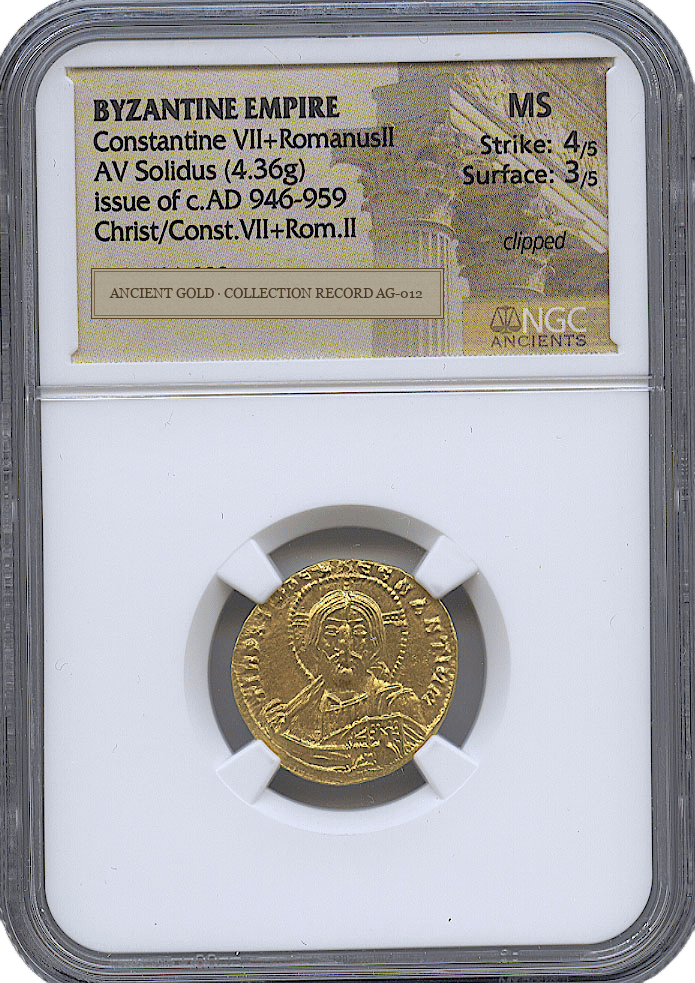
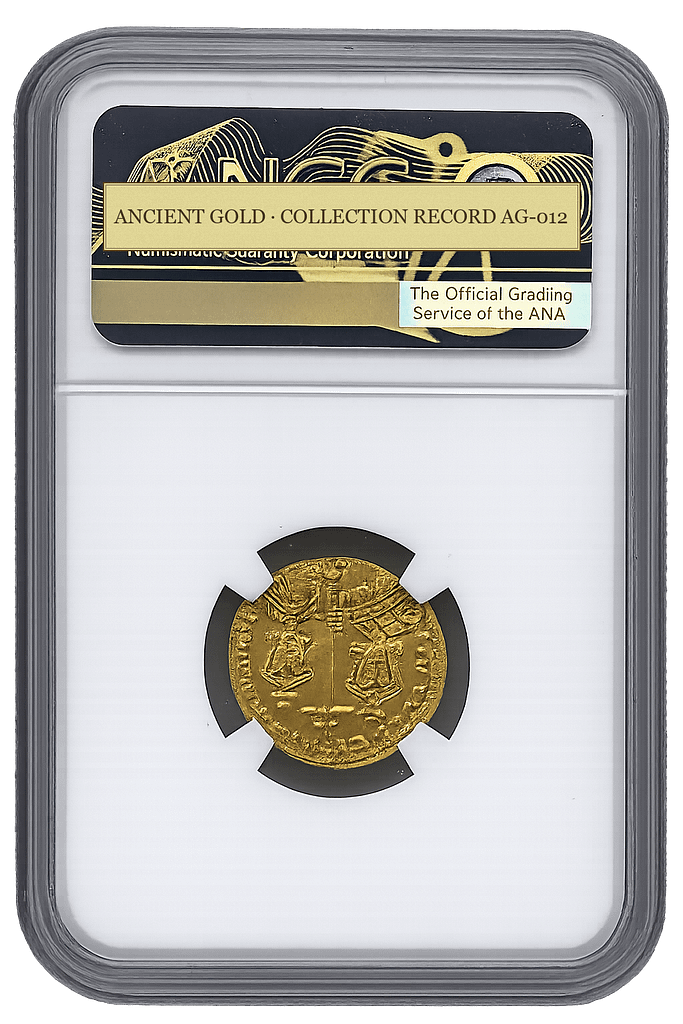
The gold coin of Constantine VII and his son Romanus II belongs to a moment when the court of Constantinople had learned to make hierarchy visible. Its two faces do not offer a narrative in the ordinary sense. They establish an order. Christ appears first, frontal and blessing, named as the ruler of rulers. On the other side the two earthly emperors share a patriarchal cross, unequal in age and costume but joined within a single dynastic image.
That arrangement condensed theology, ceremony and succession into an object weighing little more than four grams. The coin paid officials and soldiers, travelled through markets and treasuries, crossed frontiers as tribute or diplomatic gift, and could be stored for generations. Wherever it went, its gold and its imagery carried the same proposition: Roman government was legitimate because it stood beneath divine kingship and continued through an ordered imperial family.
A Nomisma Before the Histamenon
The title “histamenon nomisma” is familiar in modern descriptions of Byzantine gold, but it requires care here. Constantine VII died in 959. The technical distinction between the full-weight histamenon and the lighter tetarteron belongs to the reign of Nikephoros II Phokas, beginning in the 960s. Constantine’s coin was known in its own time simply as a gold nomisma—the continuation of the Roman solidus—or, in modern catalogues, as a solidus.
Later usage gave the established full-weight coin the name histamenon, “the standard” or “standing” nomisma, to distinguish it from the new lightweight issue. In that retrospective sense Constantine’s solidus belongs to the histamenon tradition, but it was struck before the word marked a separate denomination. The distinction matters because Byzantine monetary language changed while the underlying standard endured.
Since the fourth century, the solidus had been struck at seventy-two to the Roman pound, with a theoretical weight of about 4.5 grams. The Ancient Gold specimen weighs 4.36 grams and has been clipped, a physical history that explains its departure from the standard more readily than any monetary reform. Despite individual losses at the edge, the tenth-century gold nomisma remained one of the Mediterranean world’s most trusted stores of value.
Its reliability was political. A gold coin accepted by weight and reputation made the emperor present far beyond the palace. Purity, module and design were attributes of sovereignty no less than the crown or the throne. When Constantine VII placed Christ and his heir upon this stable medium, he joined a durable monetary institution to a carefully reconstructed dynasty.
Born in the Purple, Kept from Power
Constantine’s epithet Porphyrogennetos—“born in the purple”—asserted more than courtly splendour. He was born in 905 in the Porphyra, the chamber reserved for imperial births, as the son of Leo VI. The claim was especially valuable because the circumstances of his parents’ marriage had been bitterly disputed. Birth within the palace supplied a language of legitimacy that political experience repeatedly denied him.
He was crowned as a child in 908 and became senior emperor in name in 913. Effective government first belonged to regents, including his mother Zoe, and then to the admiral Romanos Lekapenos. Romanos married his daughter Helena to Constantine, assumed the imperial title in 920 and promoted his own sons. For almost a quarter-century the purple-born Macedonian emperor remained inside the ruling college but away from its centre.
The arrangement ended violently within the imperial family. Romanos I was deposed by his sons Stephen and Constantine in December 944; a few weeks later they too were removed. Only in January 945 did Constantine VII become the dominant ruler. At Easter he crowned his young son Romanus II co-emperor. The succession that appears calm and inevitable on the gold coin was therefore the answer to decades of regency, senior colleagues and competing dynastic claims.
The image does not recount those conflicts. Byzantine coinage rarely did. It resolves them. Constantine is shown in the privileged position, mature and vested in the loros, while the smaller, beardless Romanus wears the chlamys. They hold one cross between them. Difference is acknowledged, but competition has disappeared.
Christ, King of Those Who Rule
The obverse bears the facing bust of Christ Pantokrator. A cross-nimbus marks the halo; the right hand is raised in blessing, while the left holds the book of the Gospels. The legend, in the conventional compressed lettering of Byzantine coinage, reads Jesus Christ, King of those who rule: IhS XPS REX REGNANTIUM.
This was neither the first Christian symbol on Roman money nor the first imperial coin to depict Christ. Crosses and Christograms had long appeared in the currency, and Justinian II had introduced a full image of Christ on his gold coinage in the late seventh century. After the period of Iconoclasm, the image returned under Michael III and Basil I. Constantine’s type belongs to that restored tradition, but its placement remained a strong statement. Christ, not the emperor, occupies the obverse.
The word “portrait” can be misleading. The die engraver was not attempting to recover the physical appearance of the historical Jesus. He worked within an iconographic type: frontal gaze, ordered garments, blessing hand, Gospel book and cruciform halo. Repetition made the figure legible. Variations between dies reveal the hands of individual engravers, yet the authority of the image depended upon continuity rather than novelty.
The legend completes the hierarchy. The emperors on the reverse are rulers of the Romans, but Christ is the ruler of rulers. Their authority is real and emphatic; it is also derivative. Turning the coin from one face to the other moves from the eternal sovereign to the temporal officeholders who govern beneath him.
Father, Son and Patriarchal Cross
On the reverse, Constantine VII and Romanus II face the viewer. Constantine stands to the left, the place of seniority in this composition. His loros, the long jewelled ceremonial garment wound around the body, associates him with the most elevated rituals of the court. Romanus, smaller and beardless, wears the chlamys, a cloak fastened at the shoulder. Scale, age and dress state the order that the shared title alone could not.
Between them rises a patriarchal cross with two horizontal bars. Both emperors grasp it. The cross is a Christian sign, a ceremonial object and the vertical axis of the design. It separates father and son while also binding them into a single composition. Neither ruler possesses it alone.
The surrounding legend names Constantine and Romanus as augusti and rulers of the Romans. The language is compressed by the narrow flan, but the message is exact. The junior emperor is not a private heir waiting outside government. He has entered the imperial college. At the same time, the visual distinctions prevent co-rule from becoming parity.
For Constantine this dynastic clarity had unusual force. He had spent much of his life sharing titles with men who eclipsed him. His son’s promotion allowed him to define co-emperorship on his own terms: Romanus was legitimate because he descended from the purple-born emperor, and junior because the father remained the source of his place within the earthly hierarchy.
Ceremony as Government
Constantine VII’s reign is associated with an extraordinary programme of compilation. Works produced under his direction or patronage gathered material on court ceremony, provincial administration, diplomacy, military expeditions, agriculture and the history of the empire. Modern titles such as De Ceremoniis, De Administrando Imperio and De Thematibus can make these texts resemble detached scholarship. They were also instruments of rule.
The Book of Ceremonies preserves an ideal of taxis: order expressed through movement, costume, acclamation, rank and place. Ceremony was not decoration applied after political decisions. It made the constitution of the court visible. It showed who approached the emperor, where each dignity stood, what garments signified office and how earthly rule related to the Church and to God.
The coin operates on the same principle at another scale. Christ is placed first; the senior emperor is distinguished from the junior; both are aligned around the cross; the legends identify the ranks. What a palace procession distributed through space and time, the solidus fixes within two circular fields.
Gold extended that ordered image beyond occasions witnessed by the court. A recipient did not need to attend a coronation or an imperial feast to encounter the hierarchy. Payment itself transmitted it. The coin was an official object whose material value encouraged preservation and whose repeated handling made the imperial settlement familiar.
The Macedonian Settlement
The years of Constantine’s effective rule, 945–959, coincided with renewed military and cultural confidence. Campaigns in the east did not always succeed, but experienced commanders and an increasingly capable state prepared the advances associated with the later tenth century. Diplomatic exchange reached far beyond imperial territory. At court, the recovery and arrangement of earlier knowledge presented Constantinople as the guardian of Roman order.
The coin’s conservatism belongs to that programme. Its artistic strength does not depend upon naturalistic portraiture or a new reverse scene. Instead, it arranges inherited forms with exceptional economy. Christ Pantokrator, the loros, the chlamys, the patriarchal cross and the Roman imperial titles all carried accumulated meaning.
Romanus II succeeded his father in 959 and ruled until 963. His reign was brief, but the dynastic line continued through his sons Basil II and Constantine VIII. The paired image on Constantine VII’s solidus thus anticipated a succession that would shape the empire for more than half a century. It was not a guarantee—Byzantine succession never was—but it proved more durable than many such claims.
The Surviving Coin
The Ancient Gold specimen preserves the essentials of the type with unusual immediacy. Christ’s blessing hand and Gospel book remain legible; the two emperors flank the long cross; the differences in their dress and scale can still be read. Its NGC grade of Mint State records the absence of circulation wear, while the separate strike and surface assessments describe how the design was transferred and what happened to the metal afterward.
The noted clipping belongs to the object’s later history. Gold coins were vulnerable to the removal of small amounts of metal, whether in circulation or during subsequent handling. Clipping changes the flan and may take portions of the border or legend, but it does not erase the coin’s primary evidence. Weight, edge and missing circumference must be read alongside the surviving designs.
Hand engraving also makes every die distinct. The spacing of letters, modelling of faces, form of the cross and distribution of pellets can connect a specimen to others struck from the same dies. Such comparison moves beyond the broad attribution to Constantine and Romanus. It places the coin within the working sequence of the Constantinopolitan mint.
Its deepest interest lies in the conjunction of object and argument. The piece is gold measured to an inherited Roman standard; an image of Christ made current through orthodox worship; a record of a father’s seniority and a son’s succession; and a fragment of the ceremonial world that Constantine VII laboured to order. Theology, money and dynasty were not separate themes compressed by modern interpretation. On this coin they were struck together.