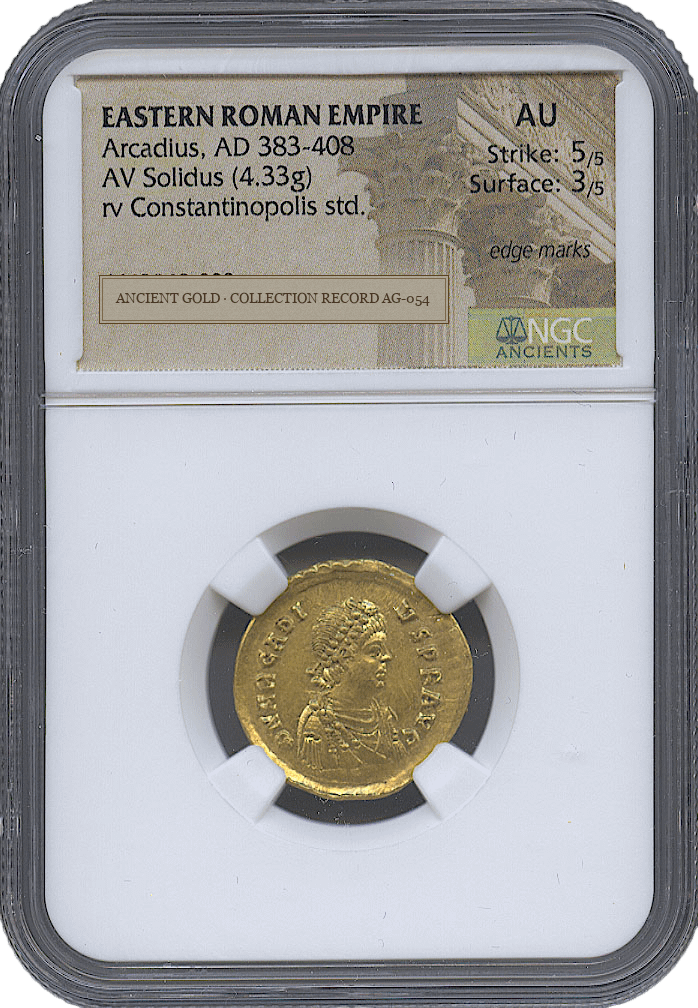
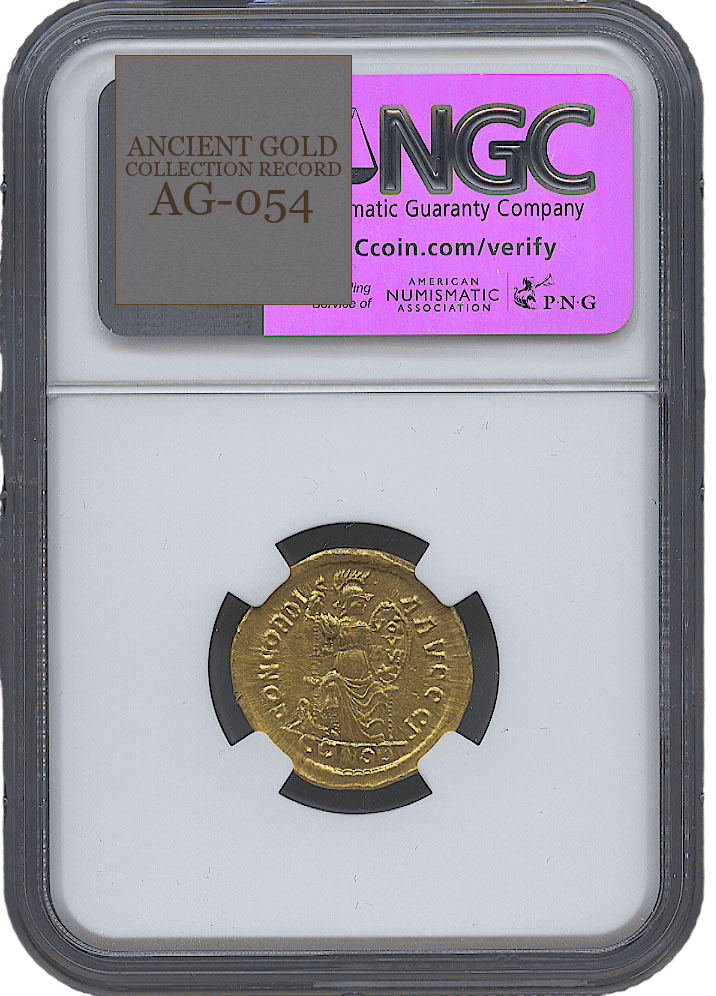
A gold solidus seldom announces uncertainty. Its weight, fabric and formal inscriptions were designed to do precisely the opposite: to make authority appear measurable, legitimate and durable. The solidus of Arcadius considered here was struck at Constantinople when its named emperor was still very young. On one face stands the court’s answer to succession, a carefully ordered portrait of the junior Augustus. On the other, Constantinopolis sits enthroned above the prow of a ship, receiving the vows of government upon her shield. The two images belong together. A dynasty speaks through the emperor; the capital guarantees that the dynasty has a centre.
A Child Within the College of Emperors
Arcadius was proclaimed Augustus by his father Theodosius I in AD 383, before he was six years old. He did not become sole ruler of the eastern provinces until 395, and even then the practical conduct of government remained in the hands of powerful ministers, generals and court officials. Coins issued in his name before 395 should therefore not be read as the autonomous statements of a mature sovereign. They belong to a collegiate imperial system in which the existence of several Augusti was presented as concord rather than competition.
The obverse legend, D N ARCADIVS P F AVG, expands to “Our Lord Arcadius, Pious and Fortunate Augustus.” Nothing in that titulature acknowledges childhood. Roman imperial language made office larger than the person who temporarily occupied it. The rosette-diademed, draped and cuirassed bust similarly compresses multiple claims into a single profile. The diadem marks sovereignty; the cloak places Arcadius within the ceremonial court; the cuirass assigns military capacity to an emperor too young to command an army. Portraiture here is constitutional theatre. It shows what an Augustus must be.
Constantinopolis Enthroned
The reverse gives the coin its particular historical intelligence. Beneath the legend CONCORDIA AVGGG, Constantinopolis is seated facing, her helmeted head turned to the right. One foot rests upon a prow, an old visual shorthand for maritime power and for the city’s command of the routes joining the Mediterranean and the Black Sea. She holds a long sceptre and a shield inscribed VOT / V / MVL / X: vows for five years of rule, with the hope of many more to ten.
These are not decorative numbers. Imperial vows were public statements of continuity, renewed at anniversaries and translated across ceremonies, inscriptions and coinage. The formula looks forward. It acknowledges a completed or anticipated quinquennial cycle while making ten years the next horizon. On a coin of a child emperor, that promise carried unusual force. The state proclaimed not merely that Arcadius occupied office, but that his rule possessed a future.
The three final letters of AVGGG are equally deliberate. They refer to the concord of three Augusti within the ruling college. Multiplicity could be dangerous in Roman politics, yet official imagery converted it into agreement. The seated capital, the vows on the shield and the plural titulature create an image of an empire whose several rulers remain bound within one legitimate order.
Reading the Mint
The reverse closes with CONOB. In late Roman gold this formula identifies Constantinople and advertises the monetary standard associated with refined gold. The Greek letter gamma marks the third officina, or workshop, within the mint. Such letters are small, but they are not incidental. They locate production within the administrative machinery that turned bullion into imperial money, and their combinations allow numismatists to distinguish issues that otherwise share the same design.
The present piece weighs 4.34 grams and measures 21 millimetres, close to the expected scale of the late fourth-century solidus. Its attribution to RIC IX 70c, with an officina variant, places it within the votive CONCORDIA series of Constantinople. The extremely fine preservation matters because the argument of the type depends on small signs: the rosettes of the diadem, the letters upon the shield, the workshop mark and the prow beneath the personification’s foot.
The Coin as an Imperial Settlement
Later history can make Arcadius seem passive, overshadowed first by Theodosius and then by the commanding personalities around his own court. This solidus asks to be read on different terms. It is evidence for the institutional strength of an imperial system capable of investing a child with a complete public identity. The coin does not reveal Arcadius’s character. It reveals what government needed his image to accomplish.
Gold gave that message reach. A solidus could move through military payments, court distributions, taxation, gifts and long-distance exchange without losing the authority stamped upon it. Wherever this piece travelled, its imagery joined the body of the young Augustus to the permanence of Constantinople. Concord was not reported as a political fact; it was asserted as the condition of Roman order. The result is a small but unusually articulate document of dynastic rule at the close of the fourth century.