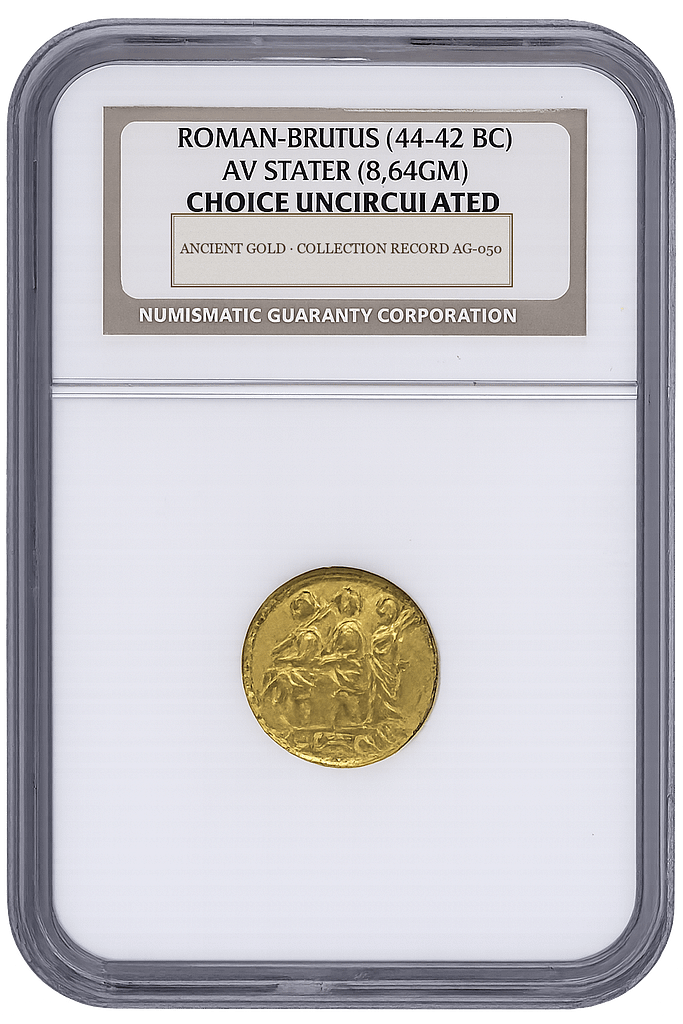
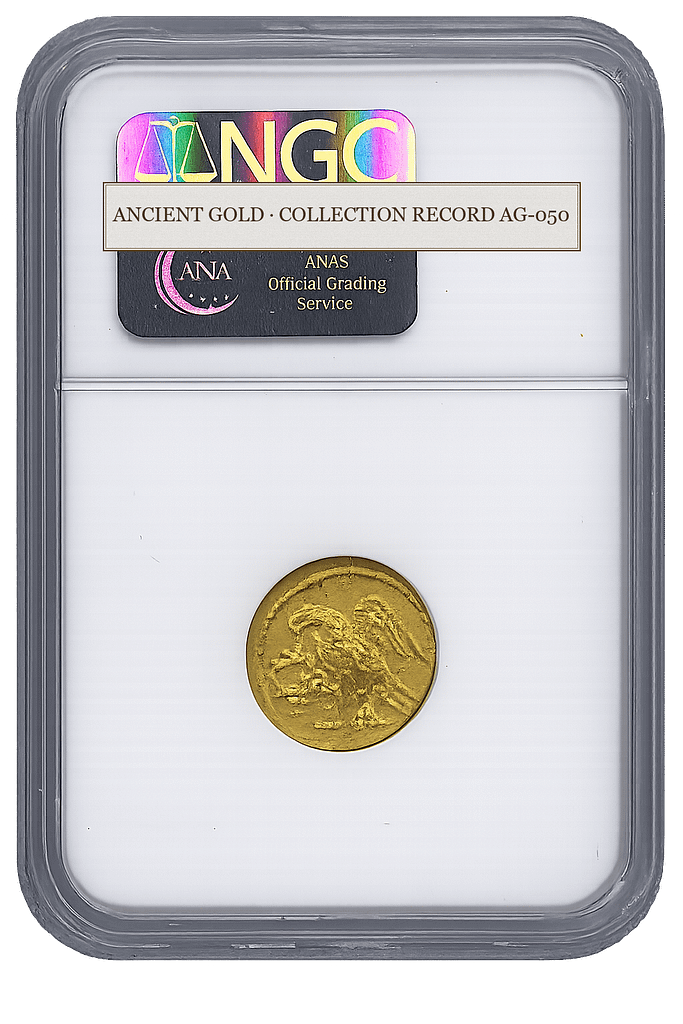
The gold staters bearing the name KOSON combine Roman Republican imagery with production beyond Rome during the upheavals following Julius Caesar’s assassination. AG-050 is traditionally associated with Brutus and dated about 44–42 BC. Its obverse shows a consul advancing between two lictors; its reverse presents an eagle with wreath and sceptre. The type looks backward precisely because the political future was uncertain.
The procession makes office visible
Lictors carrying fasces identify Roman magistracy and coercive authority. The central figure is commonly connected with the ancestral example of Lucius Junius Brutus, remembered as a founder of the Republic. The scene turns constitutional memory into a portable image. It does not show an everyday procession; it stages legitimate office.
An eagle with two kinds of power
The reverse eagle evokes Jupiter and command. The wreath signals victory, while the sceptre expresses rule. Together they complicate any simple opposition between “Republican liberty” and power: those who fought under Republican language still required military authority, resources and signs of success.
Why the attribution remains careful
Koson coinage has generated debate about issuer, minting authority and historical circumstances. A responsible record distinguishes the visible legend and imagery from the traditional association with Brutus. The coin can securely support analysis of its symbols even where a complete political narrative remains contested.
Gold in a civil-war economy
High-value gold was suited to military payment, elite transfers and concentrated reserves. That does not reveal the route taken by this individual specimen. It explains why competing authorities valued gold issues: money moved resources while its designs argued that the issuer’s command was lawful.
Questions readers ask
Does KOSON name a king?
The legend names Koson, but the identity and political status behind that name remain debated. Catalogue language should preserve that uncertainty.
Is the central figure Brutus?
The scene is better read as an ancestral or consular type than as a straightforward contemporary portrait. Its power comes from Republican memory.
Why place this article in the Roman section?
The coin was produced outside Rome, yet its imagery and historical setting engage directly with Roman magistracy, civil war and the collapse of the Republic.