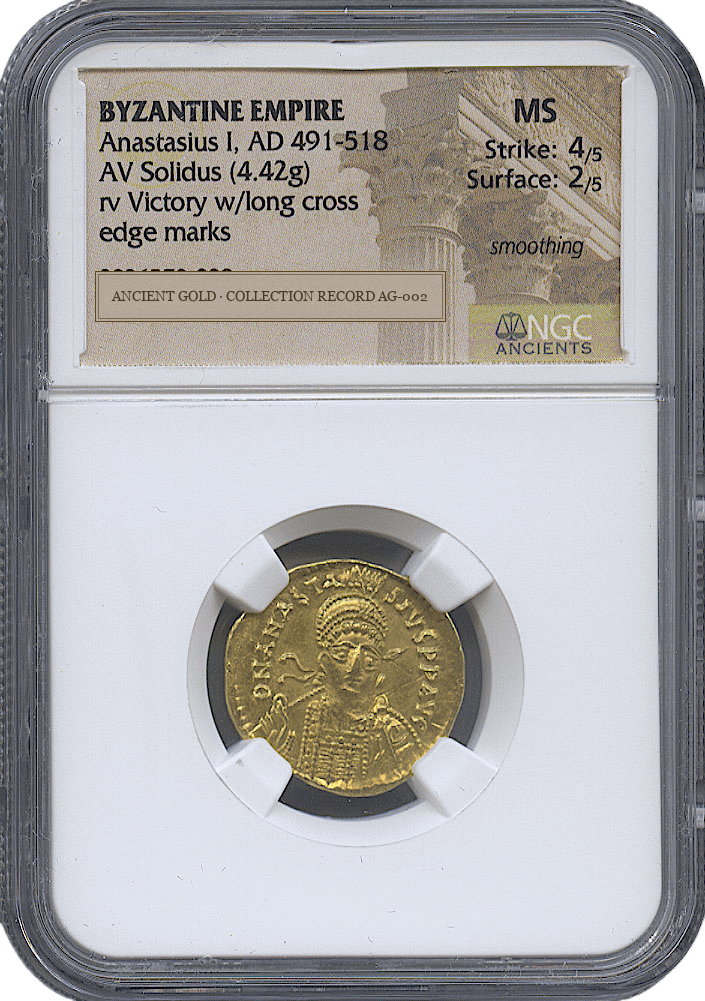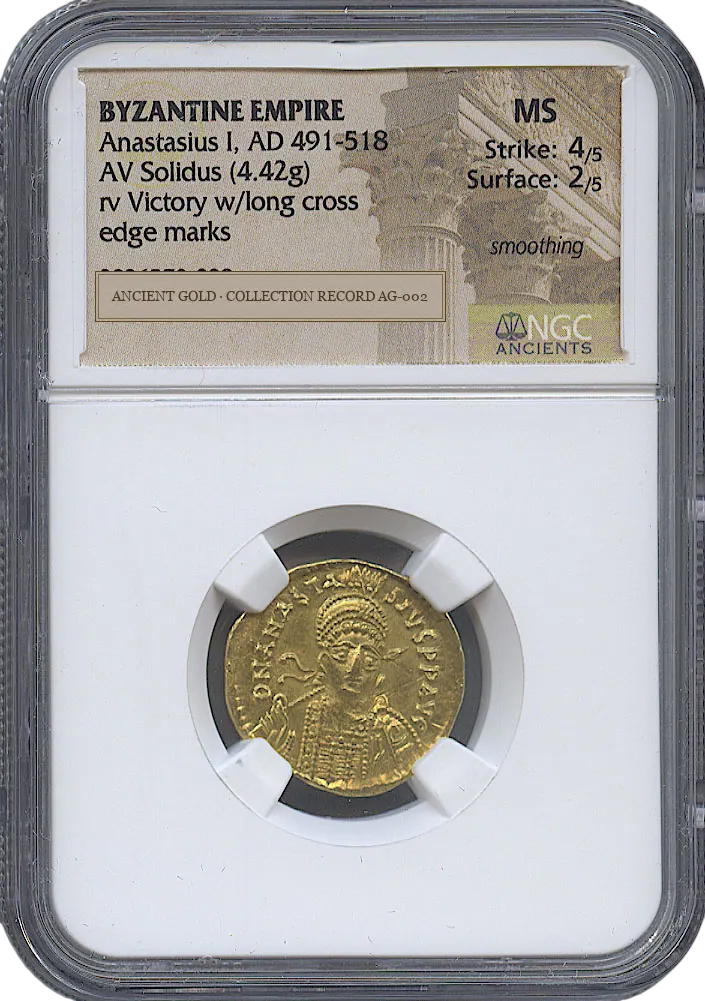
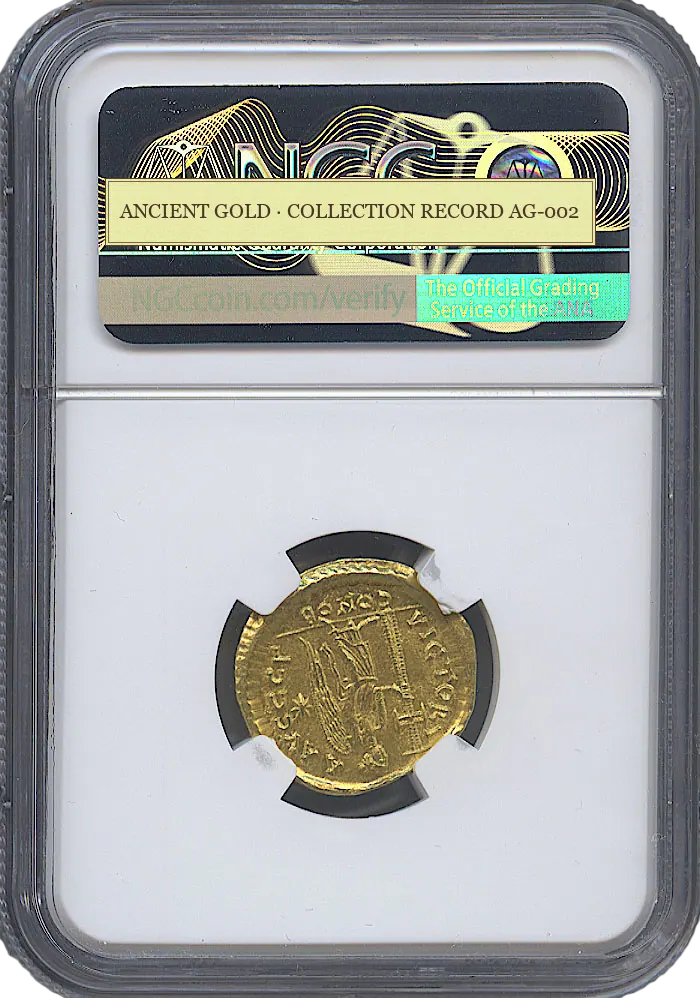
Anastasius I inherited institutions, titles and images that were Roman, while ruling from the capital of the state modern historians call Byzantine. AG-002 makes that continuity visible. The emperor appears as an armoured guardian; Victory carries a long cross. Classical form and Christian sign are not competing labels on the coin. Together they define imperial success.
The solidus as an inherited standard
The gold solidus had already served imperial government for generations. Anastasius is famous for reforming bronze denominations, but the continued gold standard was equally important. It allowed high-value payments and reserves to rely on a familiar monetary form while the state reorganized other parts of its currency.
Military office, not intimate likeness
The frontal, helmeted bust is highly formal. Its purpose is not to reveal the emperor’s personality. Spear, shield and armour make the ruler’s protective duty immediately legible. Similarity across issues is a strength: each coin presents the office as disciplined and continuous, even though individual dies vary.
Victory carries the cross
On the reverse, a winged figure holds a long monogrammatic cross. The figure retains the body of Roman Victory, but the object she carries directs triumph toward Christian authority. The combination warns against dividing every motif into either “pagan” or “Christian.” Official imagery could preserve an effective personification while changing the framework in which viewers understood it.
What this object can establish
AG-002 is dated AD 491–518 and weighs 4.42 grams. It can document the type, metal, recorded weight and present condition. It cannot alone prove where every coin of the issue circulated or how every user interpreted Victory. Those larger questions require hoards, written evidence and comparison across many specimens.
Questions readers ask
Was Anastasius a Roman or Byzantine emperor?
His government understood itself as Roman. “Byzantine” is a modern convention useful for describing the medieval eastern Roman state.
Did his reform change the solidus?
His best-known monetary reform reorganized bronze. The gold coin’s continuity was itself a valuable policy.
Why keep Victory after Christianization?
Her form remained an efficient sign of imperial success and could be adapted by placing an explicitly Christian cross in her hands.