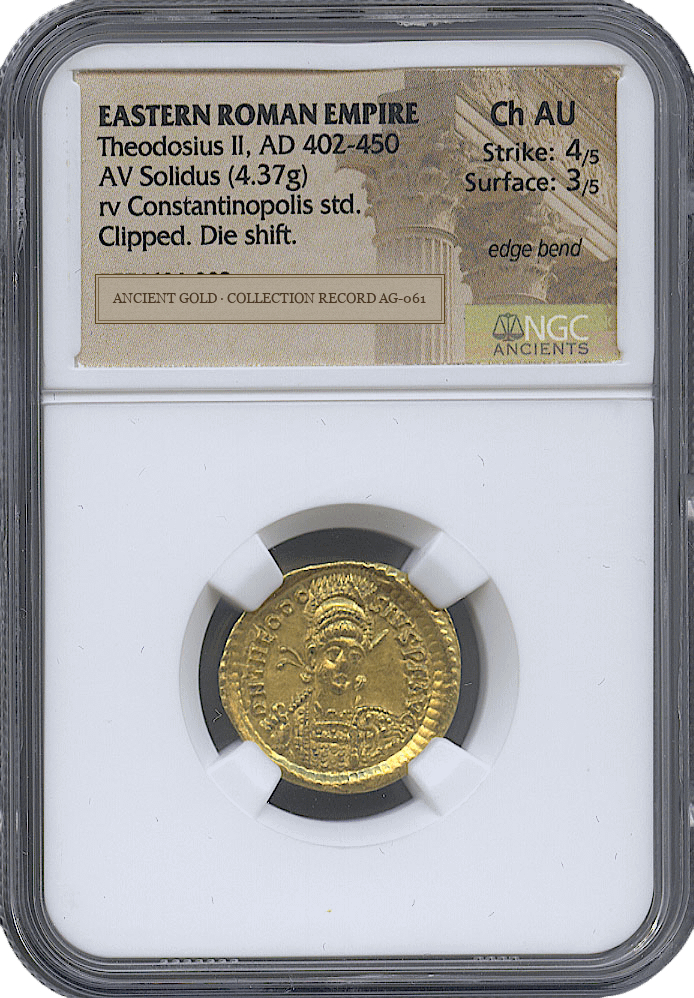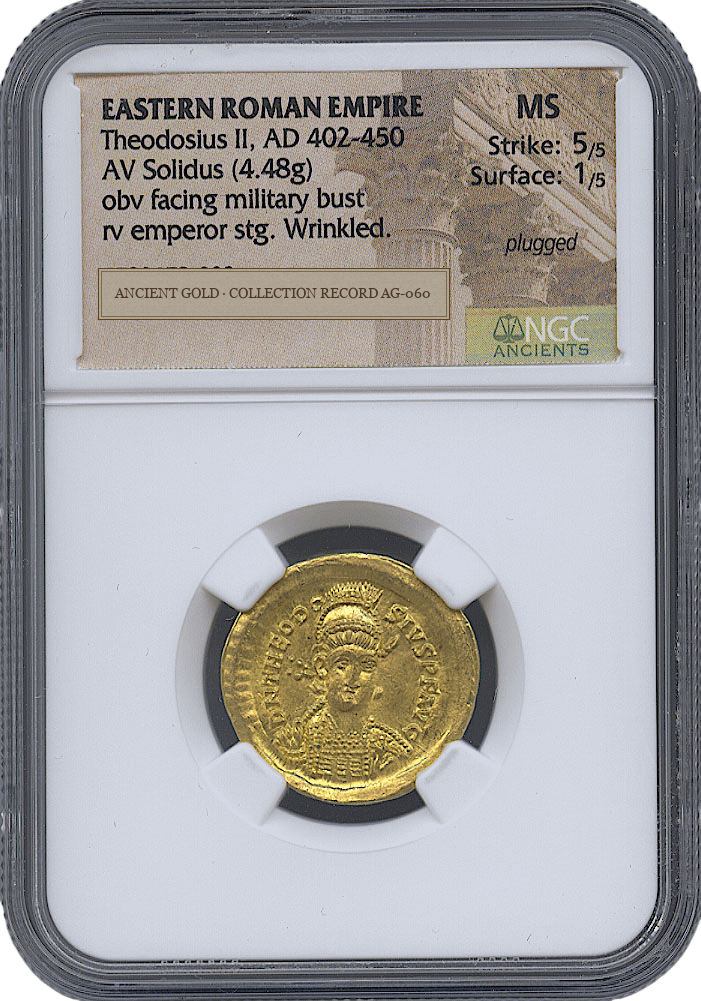
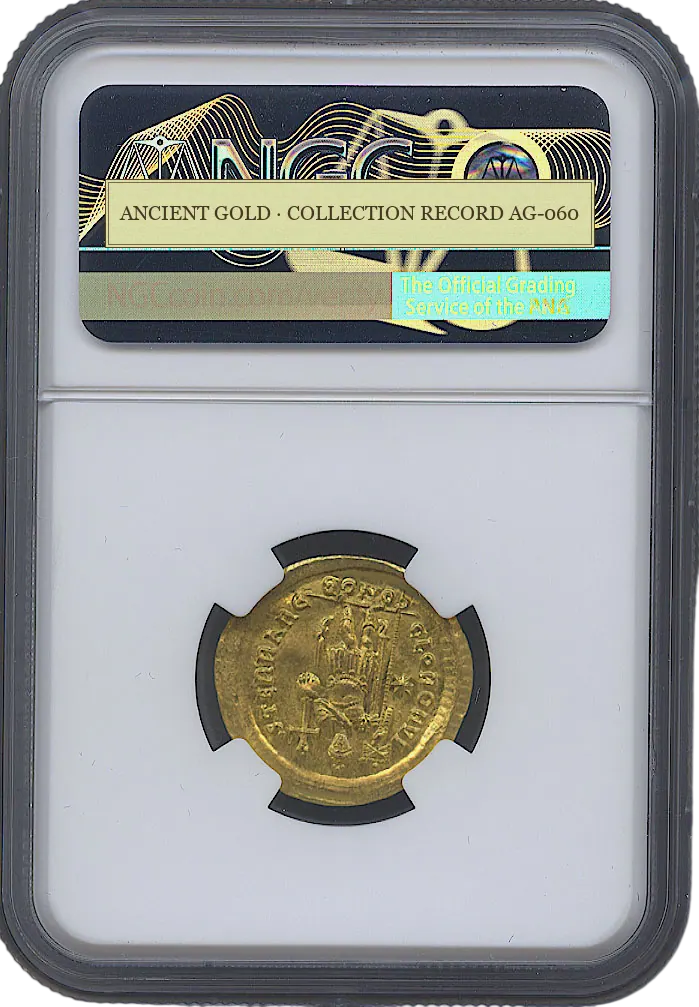
The facing military portrait of Theodosius II makes the emperor appear less like a private individual than the permanent, armed centre of government. AG-060 and AG-061 share that commanding obverse, yet their reverses direct the message differently. One joins the ruler to victory; the other gives the capital itself a body, throne and authority.
A portrait designed to confront
The emperor faces the viewer in helmet and cuirass, holding spear and shield. Earlier profile portraits allow the gaze to pass across the field. This frontal type meets the viewer directly. Armour declares vigilance, while the symmetry and formality turn military equipment into court ceremony. The result is both soldier and icon of office.
Victory and a Christian empire
AG-060 preserves a reverse in which winged Victory remains useful to an officially Christian state. The older personification had not simply vanished. Crosses and Christian attributes could redirect her meaning, allowing Roman triumph to be presented within a new sacred order. The design demonstrates adaptation rather than an overnight replacement of pagan imagery.
Constantinopolis enthroned
AG-061 instead presents Constantinopolis seated, holding instruments of command and a cross-topped globe. A city personification turns buildings, institutions and population into a single legible figure. Under Theodosius II, the capital’s monumental walls and administrative role made that personification especially forceful: the emperor guards the state, and the enthroned capital embodies its endurance.
Two objects, two histories
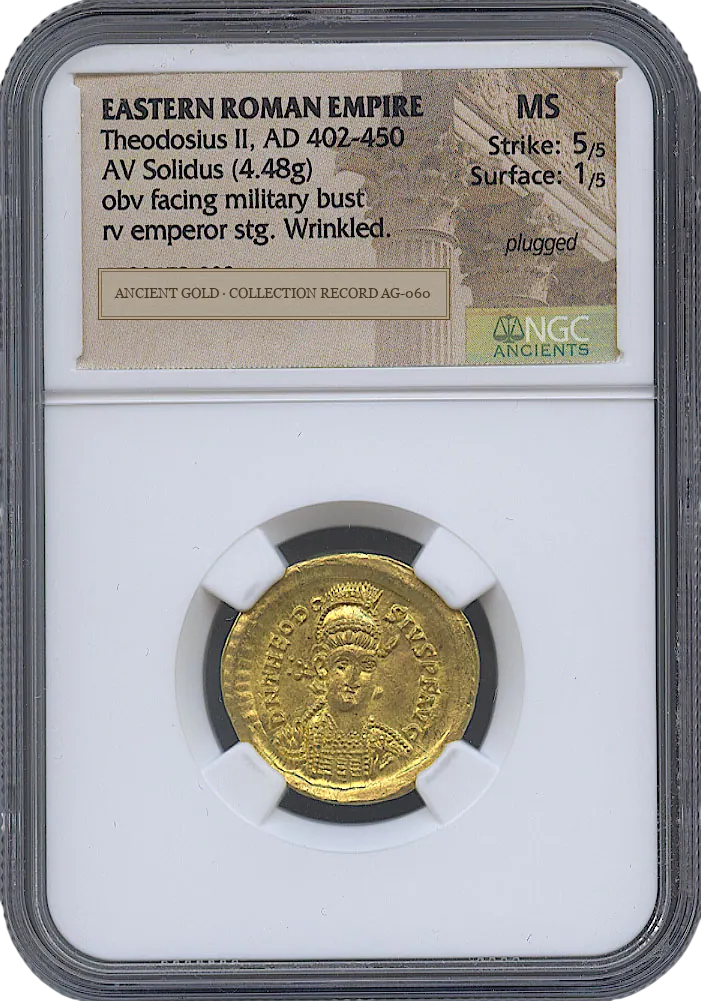
AG-060 weighs 4.48 grams and is recorded as plugged. AG-061 weighs 4.37 grams and records clipping, a die shift and an edge bend. These are not interchangeable examples. Their different surfaces and reverses show why a catalogue must separate the history of a type from the later physical history of each surviving coin.
Questions readers ask
Is Constantinopolis a portrait of a real empress?
No. She is a personification of the imperial capital, identified by attributes and established type.
Why use a military portrait during a long reign?
The image expresses the ruler’s duty and capacity to defend the state; it need not describe personal combat.
Do the two reverses contradict each other?
No. They emphasize complementary foundations of rule: divinely supported victory and the security of the imperial capital.