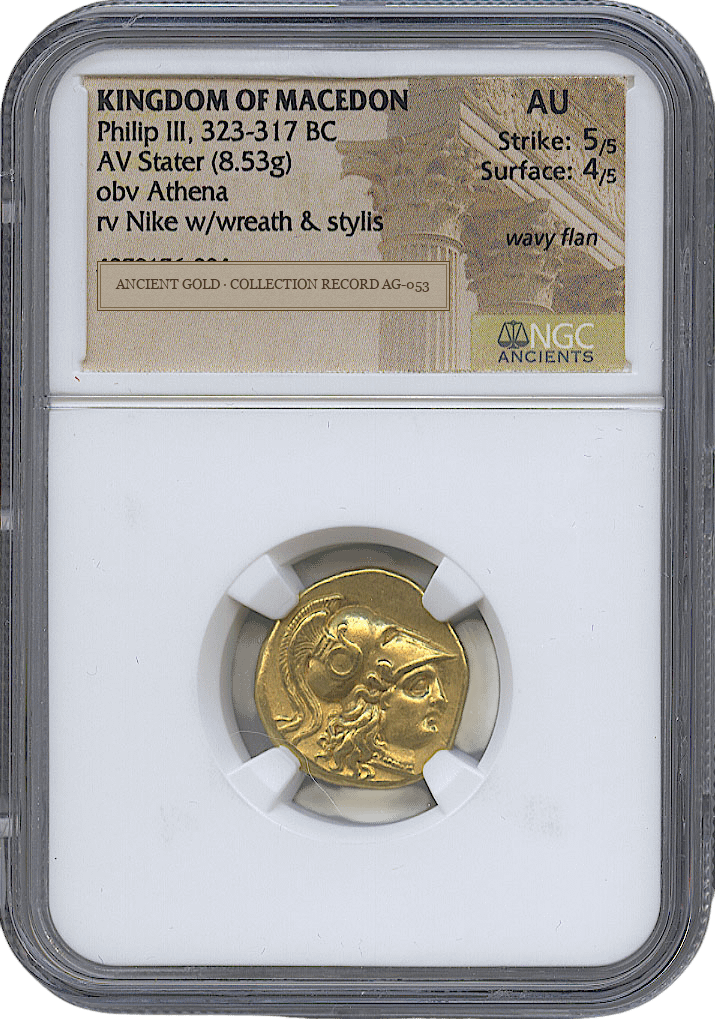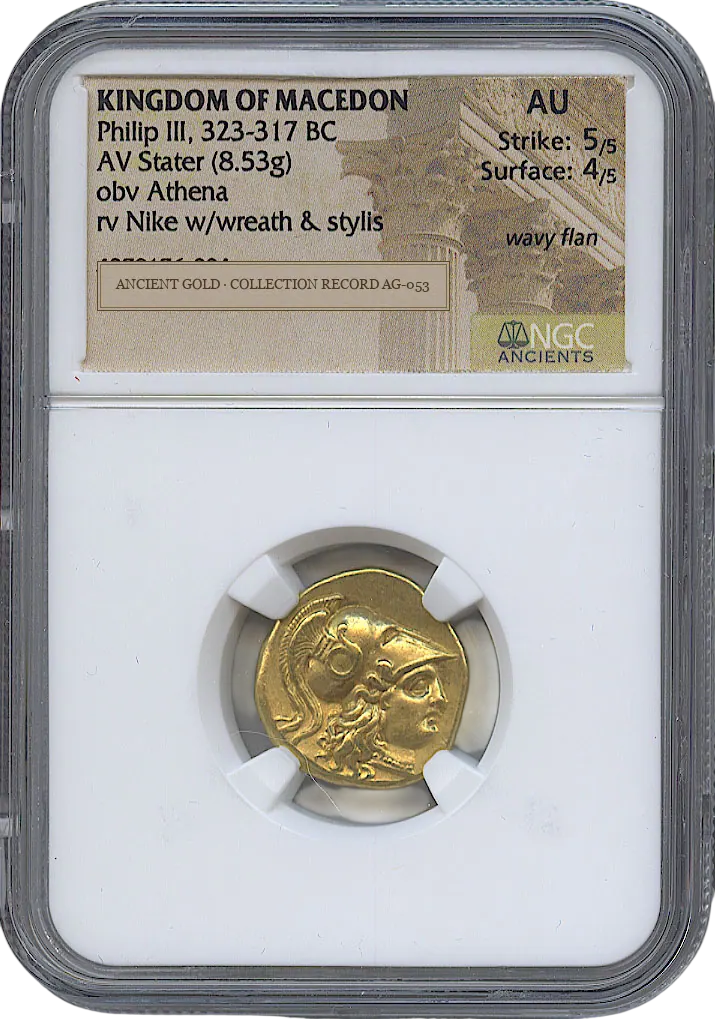
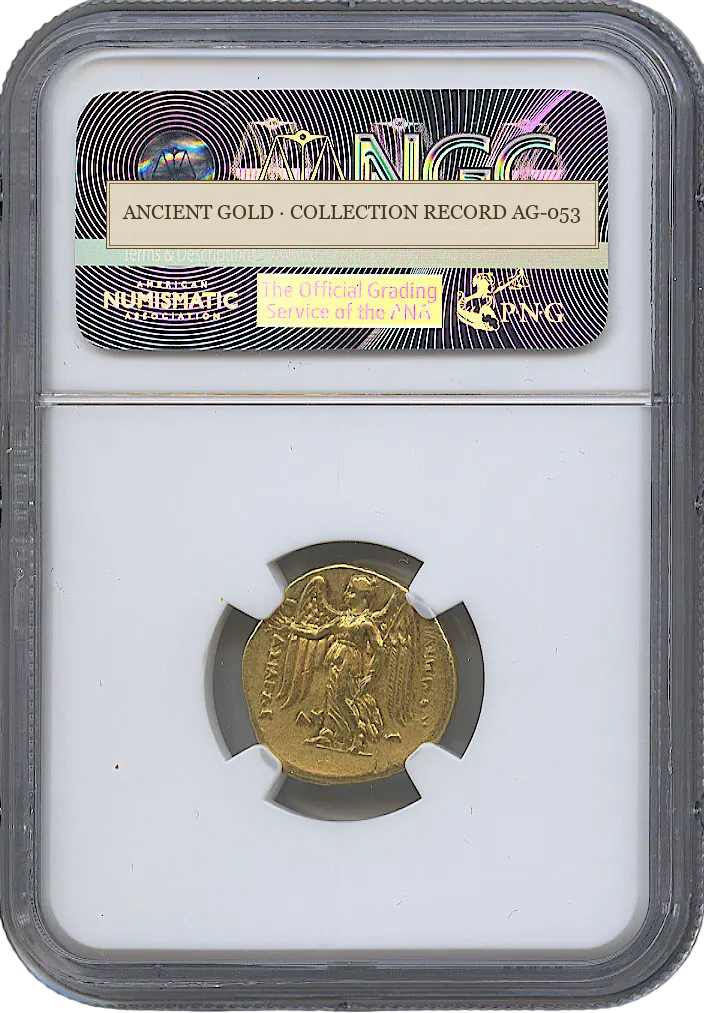
When Alexander III died in 323 BC, the empire he had conquered did not immediately acquire a stable successor. Philip III Arrhidaios carried the royal name, but military commanders competed for control of territory, armies and the court. AG-053 belongs to this unsettled world. Its helmeted Athena and standing Nike repeat a successful Macedonian gold language whose familiarity made continuity visible even when political authority was fragmented.
Athena as disciplined power
The obverse is not a portrait of Philip III. Athena faces right in a crested Corinthian helmet. Her identity combines intelligence, civic protection and readiness for war. The helmet makes the type unmistakably martial without depicting a battle, while the idealized divine head avoids dependence on the changing appearance of a mortal ruler.
Nike carries the result
On the reverse, Nike holds a wreath and stylis. The wreath signifies victory; the naval staff broadens that promise toward command and mobility. The legend names Philip, joining the king’s authority to a divine figure who embodies success. Image and inscription therefore do different work: Nike supplies the claim, while the legend identifies the authority under which the gold was issued.
Continuity can be strategic
Keeping an established type did more than honour Alexander. Recognizable gold helped transactions continue across regions familiar with Macedonian money. At the same time, the design presented Philip III as the lawful bearer of a victorious dynasty. Repetition should not be mistaken for political calm; it could be most valuable when circumstances were unstable.
Reading this specimen
AG-053 weighs 8.53 grams and is catalogued as an AV stater dated 323–317 BC. Its recorded grade describes the preservation of this specimen, not the strength of Philip’s personal rule. Attribution depends on the complete type—portrait, reverse figure, legend, symbols, fabric and comparison with published die and type sequences.
Questions readers ask
Is Athena wearing a battle helmet?
She wears a crested Corinthian helmet, a compact attribute that identifies the goddess and her martial role.
Does Nike mean that a particular battle had just been won?
Not necessarily. Nike is a durable statement of victorious authority; a connection to a single event needs additional evidence.
Why did a disputed kingdom keep striking gold?
Gold paid, stored and transferred high value. Its imagery also made an argument: legitimate Macedonian power continued under the named king.