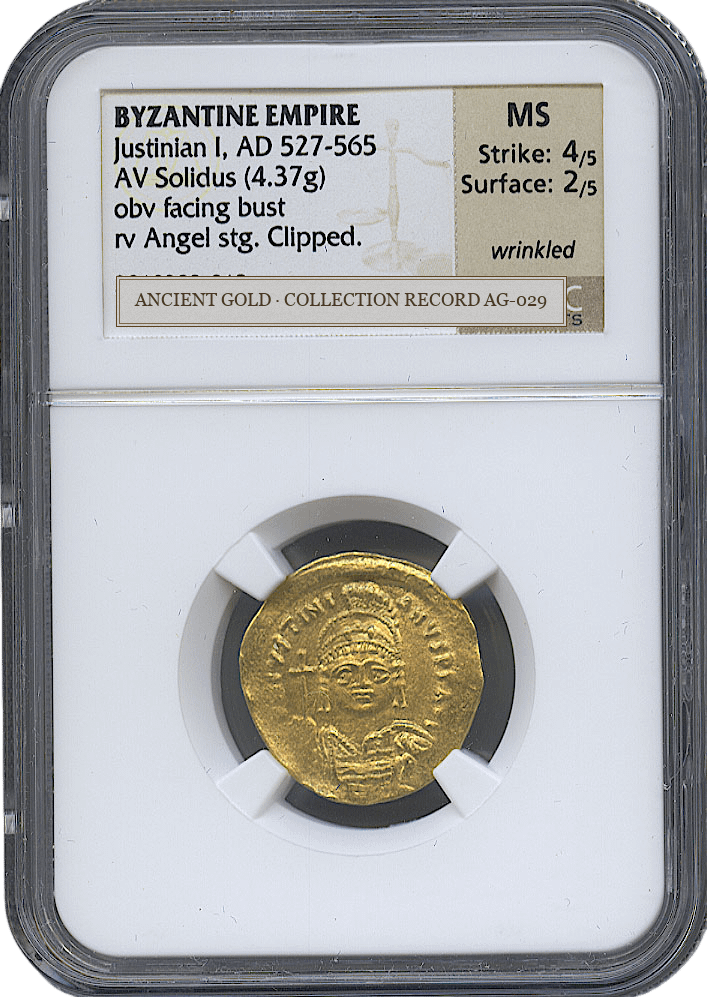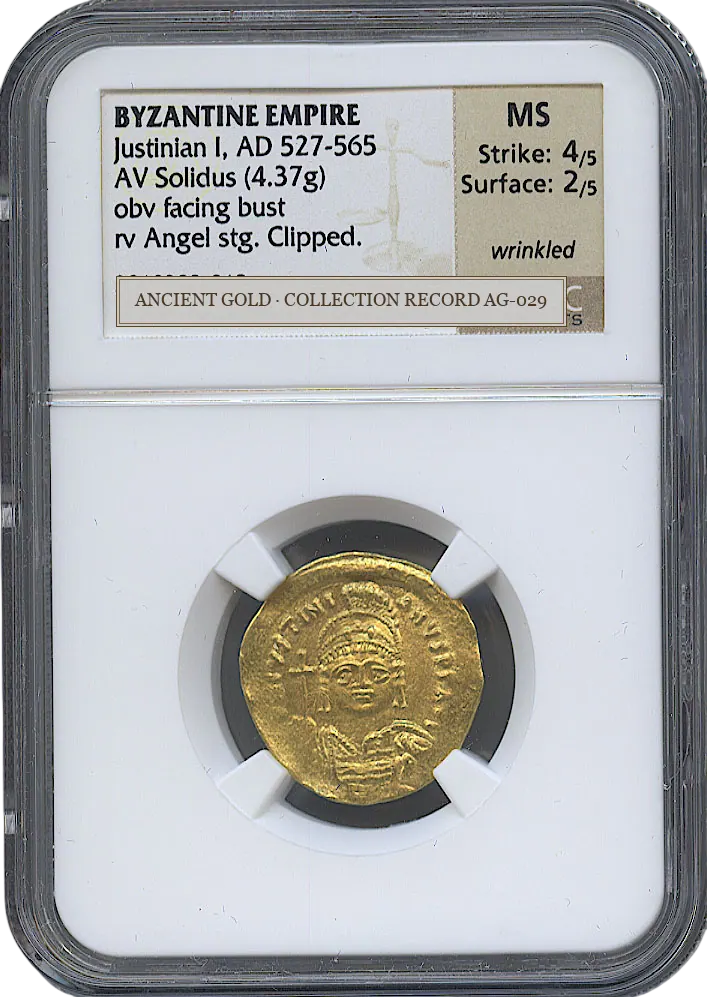
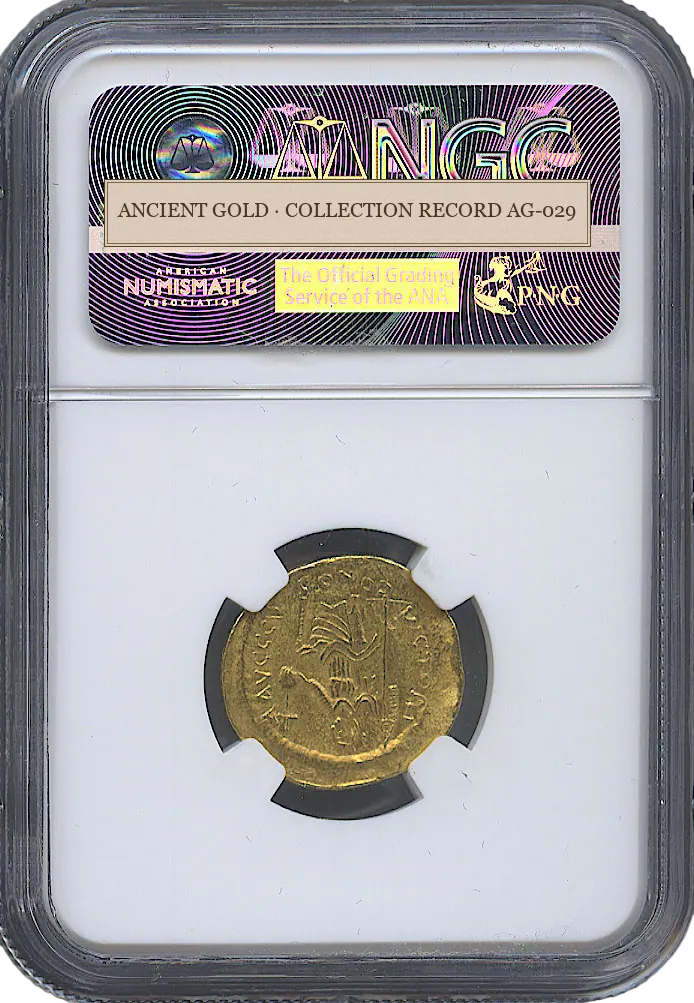
Justinian I used gold coinage to present restoration as a visible fact. AG-029 belongs to a reign associated with the codification of Roman law, major building projects and campaigns intended to recover former western territories. The coin does not illustrate those achievements separately. It compresses the programme into two authoritative figures: the facing emperor and a standing angel.
The significance of the frontal bust
Justinian’s fully frontal imperial portrait became a durable Byzantine standard. The direct gaze removes the profile’s sense of movement and turns the ruler into a symmetrical presence. Helmet, armour and imperial attributes connect ceremony to defence. The individual body is subordinated to an office meant to face every viewer in the same way.
From Victory to angel
The reverse figure inherits the pose and function of Roman Victory but is understood as an angel within the Christian imperial system. This change is not merely a new name. Wings, cross and globe present military success as something granted and ordered by God. The angel makes the theology of victory more explicit while preserving a composition familiar to users of gold coinage.
Restoration in repeated form
Monuments and legal texts reached particular audiences. Coins repeated the imperial image through taxation, salaries, gifts and exchange. Repetition mattered because restoration was a claim that needed to appear normal. Each solidus joined the state’s material capacity to its chosen explanation of legitimate power.
The surviving specimen
AG-029 weighs 4.37 grams. Its holder records clipping and wrinkling. Those condition notes should remain visible beside the historical interpretation: the idealized image of an unchanging empire survives on a physical object altered by striking, handling and later treatment.
Questions readers ask
Is the portrait realistic?
It may preserve recognizable conventions, but its primary purpose is official identity rather than intimate likeness.
Is the reverse figure definitely an angel?
In Justinian’s Christian context the winged figure with cross-bearing attributes is conventionally read as an angel, developed from the older Victory type.
Does the coin prove Justinian restored Rome?
It proves that his government represented authority in the language of restoration and sacred victory. The results of policy must be evaluated from wider evidence.